

South Piedmont and Pitt community colleges expand life sciences training
Key Takeaways
- Aseptic training: South Piedmont Community College has opened a 21,000-square-foot facility in Monroe to provide hands-on training in biopharmaceutical manufacturing
- NSF support: Pitt Community College received a $427,415 grant to expand biotechnology training and prepare students for quality control laboratory roles
- Industry alignment: Partnerships with life sciences employers are helping both colleges tailor training to the specialized skills needed across North Carolina’s growing industry
Across North Carolina, community colleges are expanding specialized training to meet the needs of the state’s growing life sciences industry. Recent efforts at two community colleges highlight the range of specialized training being developed to prepare workers for the industry.
At South Piedmont Community College in Monroe, southeast of Charlotte, a recently opened aseptic training facility is giving students hands-on preparation for careers in biopharmaceutical manufacturing.
A new $427,415 U.S. National Science Foundation grant awarded to Pitt Community College (PCC) in Winterville, near Greenville, will support technical training for bioanalytical laboratory technicians, with an emphasis on quality control.
Building biopharma workforce skills
South Piedmont’s new aseptic training facility at its Old Charlotte Highway campus in Monroe is the first facility of its kind in southcentral North Carolina. Measuring 21,000 square feet, the facility is providing technical training in several critical areas of biopharma manufacturing and operations, including chemistry and microbiology, quality systems and compliance fundamentals, and aseptic processing.
“This facility represents more than an investment in education — it is an investment in the future of our region,” said Dr. Kimberly Miller, South Piedmont’s executive director of aseptic and biotechnology programs. “By providing specialized aseptic training locally, we are helping employers access the talent they need to grow while positioning Union County as a destination for workforce development in the rapidly expanding biopharmaceutical sector.”
With state-of-the-art classrooms, advanced aseptic processing labs and simulated manufacturing spaces, the facility will be used by students in the BioWork program, a workforce credential that prepares students for entry-level jobs in biotechnology, biopharmaceutical, pharmaceutical and chemical and other advanced manufacturing.

The Aseptic Training Facility was made possible by support from the North Carolina General Assembly, the Golden LEAF Foundation, and industry partners, including Glenmark Pharmaceuticals, which donated more than $2.7 million in materials and equipment to the Aseptic Training Facility.
“Our partnership with South Piedmont Community College reflects our commitment to investing in local talent,” said Marc T. Kikuchi, president and business head – North America, Glenmark Pharmaceuticals. “Monroe has long been home to our U.S. manufacturing facility, making this collaboration a natural extension of our commitment to the community.”
By bringing aseptic training to Union County, the new facility will help meet industry demand while positioning the region as a center for biopharmaceutical workforce development.
“South Piedmont Community College is helping expand opportunities for the next generation of biopharma talent in the greater Charlotte region by giving students hands-on experience with the processes and practices essential to biopharmaceutical manufacturing,” said Corie Curtis, executive director of NCBiotech’s Greater Charlotte Office. “This specialized training helps connect students with career opportunities and builds a skilled workforce for the region’s growing life sciences industry.”
South Piedmont Community College is helping expand opportunities for the next generation of biopharma talent in the greater Charlotte region by giving students hands-on experience with the processes and practices essential to biopharmaceutical manufacturing.
—Corie Curtis, executive director, NCBiotech's Greater Charlotte Office
’NSF grant strengthening biotechnology education
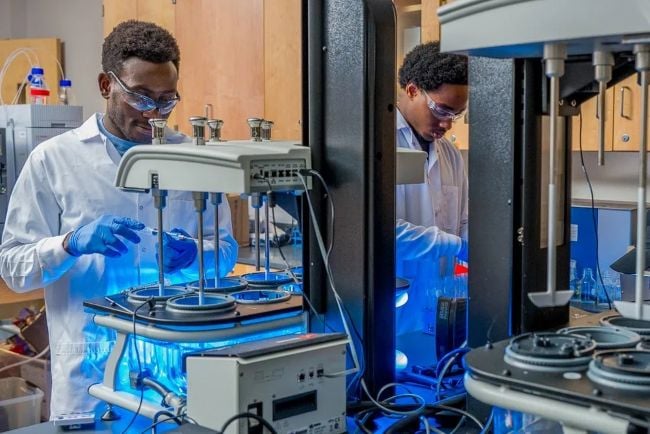
At PCC, the new NSF grant will fund a three-year project to strengthen the college’s Biotechnology Associate in Applied Science program. The support will help expand recruitment and retention efforts and enable the purchase of industry-standard laboratory equipment, modernize lab instruction and strengthen industry partnerships.
“The grant will help the college increase biotechnology enrollment and completion, expand internships and other work-based opportunities, and establish a pipeline of skilled workers ready for employment in eastern North Carolina’s rapidly growing life sciences industry,” said Christina Weeks, Biotechnology Department chair at PCC in Winterville.
Weeks, who will lead the project with assistance from PCC Biotechnology Instructor Kristen Bishop, said the goal is to produce more graduates prepared to enter the region’s growing life sciences workforce.
Thanks to the grant, students in the Biotechnology Associate in Applied Science program will receive more real-life experiences with industry-standard equipment, procedures and quality control techniques. Faculty professional development and industry engagement will also help ensure that instruction aligns with today’s workplace practices.
“We have local industry partners, including Thermo Fisher Scientific, Nipro Medical, Catalent and CMP Pharma, supporting the project and providing meaningful input that ensures our programming aligns with their workforce needs,” said Weeks.
Weeks said local employers continue to report a need for technicians with specialized skills in laboratory quality control, microbiology, environmental monitoring and regulatory compliance. The grant will help PCC expand its capacity to prepare workers for those high-demand positions.
The National Science Foundation’s Advanced Technological Education program supports educational programs that prepare highly skilled technicians for advanced technology fields that drive the U.S. economy.