

New biomechatronics apprentices receive warm welcome at Wake Tech
Key Takeaways
- Latest cohort: 2nd biomechatronics cohort gets warm welcome; students spend 2-4 weeks on biotechnology, then tackle mechanical, electrical and robotics systems
- Two corporate sponsors: CSL Seqirus & Merck sponsor 10 apprentices
- Good prospects: Job market bright for this new field
The newest cohort of North Carolina biomechatronics apprentices received an enthusiastic welcome on October 5 at Wake Technical Community College’s Beltline Education Center in Raleigh.
The 10 learners represent the second group to participate in a unique training program launched in July 2025 after extensive input from the life sciences industry, education and nonprofit workforce development partners. The first cohort completed the program in March 2026.
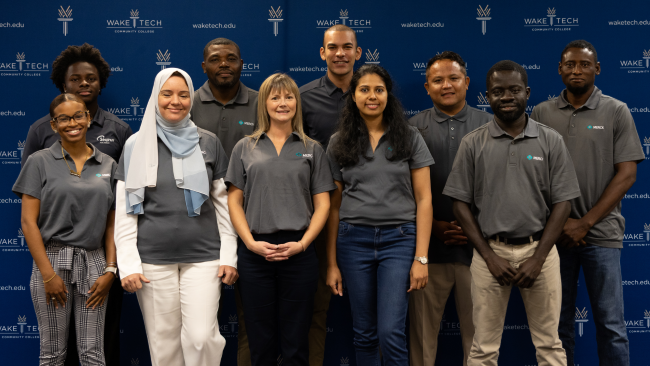
Wake Tech President Scott Ralls kicked off the celebration: “This is a big day as we initiate the second biomechatronic industry cohort,” he said. “We appreciate this year’s industry sponsors, Merck and CSL Seqirus, which are real leaders in biopharma.” This is CSL's first cohort, with two apprentices, and Merck’s second, with eight apprentices.
CSL Seqirus, based in Holly Springs, is a global leader in influenza vaccine development and manufacturing. Merck is a leading international research-intensive biopharmaceutical company with a vaccine manufacturing facility in Durham.
The apprenticeship program takes students through two to four weeks on biotechnology and then tackles mechanical, electrical and robotics systems
Strong community college partnerships
Ralls acknowledged the strong partnership with Durham Tech and recognized Beth Payne, attending in her role as dean of Durham Tech’s Center for Workforce Engagement. Wake and Durham Tech are partnering as a continuation of RTP Bio, a collaboration between the schools to address workforce training needs of regional biotech employers.
The “pioneering leadership” of NCBiotech was also recognized: Chase Barnhill, associate director, workforce development, and Jacob Key, director, workforce solutions, attended the event. Laura Gunter, president of the North Carolina Life Sciences Organization, also attended.
There is no problem we can’t solve when we work together. It’s why we come to work: to protect public health.
— Payal Patel, CSL Seqirus
’Gina Thompson, president of the North Carolina Life Sciences Apprenticeship Consortium, was pleased to greet the new students and event attendees. “Congratulations to the students, faculty and industry partners,” she said. The Consortium was founded as part of the Accelerate NC Build Back Better Regional Challenge award led by NCBiotech.
She expressed her personal passion for workforce development and what it means for students and program partners. “We will continue to see the impact of this program as we strengthen relationships between industry and education to develop meaningful pathways to life sciences careers,” she added.
‘Be curious, ask questions, network…’
Thompson’s advice to the new students: “Be curious, ask lots of questions, network and take advantage of every opportunity as you turn your education into a rewarding career.”
Wake Tech’s Leslie Isenhour, dean of biotechnologies and the BioNetwork Capstone Center division, assured the students, “We are invested in your success and engaged with you and our partners.”
Al Brewer, dean of advanced manufacturing, engineering and design, echoed her support. He worked in industry for 28 years before joining the education side. “I did personnel training and operations, so I fully believe in including resources for training that will help jumpstart your careers,” he said
He outlined the eight-month BioMechatronics Apprenticeship training program, with students spending the first two to four weeks on biotechnology, then tackling mechanical, electrical and robotics systems. “In this industry, you need to be able to identify weird sounds and what might be causing them” before calling for operations support, he said.
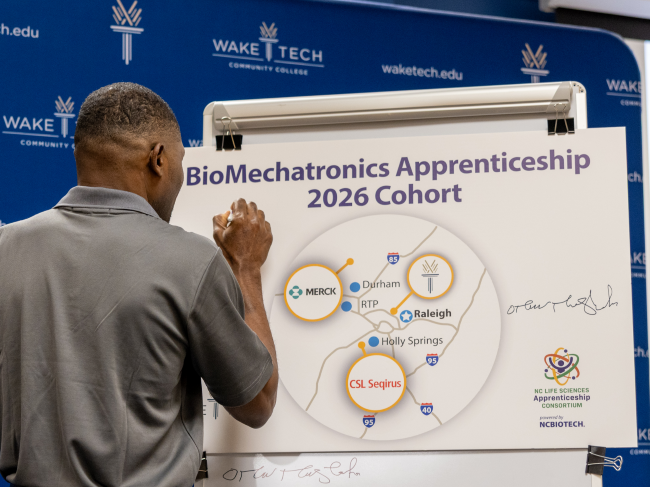
Then it was time for the companies and their interns to be recognized and come up and sign the official poster board for this year’s cohort.
CSL Seqirus, Merck introduce new learners
Payal Patel, CSL Seqirus head of engineering, introduced the company’s two apprentices. Interviewed after the event, she talked about the company’s strong culture of protecting patients and families and how important it is to educate and train the next generation of employees to collaborate successfully with teammates.
“There is no problem we can’t solve when we work together,” she said. “It’s why we come to work: to protect public health.”
Patel was joined at the event by Mark Lockette, CSL’s manager of instrumentation and calibration, and Deb Hittel, head of capital projects. Lockette is an Air Force veteran and served as an aircraft electrician. He enjoyed the opportunity to welcome the new interns and said of his CSL position, “This is the most enjoyable time in my career, especially the day-to-day dealing with people.”
Hittel has served as chair of NCLSAC and is a strong advocate for using apprenticeships to bridge generations in the workplace. As the LSAC LinkedIn profile notes, Hittel believes that apprenticeships “not only transfer critical knowledge and expertise, but also foster employee loyalty, a vital need within North Carolina’s life sciences industry.”
Elizabeth Maulhardt, Merck associate director, human resources business partner, was there to introduce the company’s new apprentices, is a big fan of the Wake Tech program. This is the company’s second cohort in biomechatronics and fourth apprenticeship-cohort overall.
She sees her role as working at the intersection of people and strategy. It can be challenging—"you’ve got to love what you do,” she said, but finds it both interesting and satisfying. So far, with four cohorts, “We have a retention rate of 100 percent,” she said, smiling.
‘Real demand’ for biomechatronic jobs
The term “biomechatronic technician” may not be familiar, in part because it is not yet listed in the U.S. Bureau of Labor Statistics Standard Occupational Classification System. A September 2026 Brookings Institution research report notes that technologies themselves often evolve too rapidly for standard data tools to capture emerging careers, providing an inaccurate picture of employment opportunities.
The report refers specifically to biomechatronic technicians. “As modern biomanufacturing facilities become more automated, firms increasingly need workers who can understand the specific processes involved in biomanufacturing while also applying mechanical and electrical skills to troubleshoot new advanced equipment, from robotic liquid handlers to automated cell culture bioreactors.
“That role is more specialized than general maintenance work and can help facilities reduce downtime. In government data, the job would be lumped into roles such as industrial machinery mechanics, mechanical engineers, or bioengineers. But if you relied only on those existing categories, you would have a hard time understanding the job’s distinct needs.”
That makes industry/workforce development collaborations all the more important. The report highlights the pioneering biomechatronic apprenticeship program at Wake Tech.
“In North Carolina, a biomanufacturing hub, employers and educators are already treating this combination of skills as a distinct occupational need. Job postings from [biopharma] companies show they are asking for workers who combine knowledge of regulated pharmaceutical manufacturing with advanced skills in automation and industrial controls. …The job appears to have real demand, but it is not yet showing up clearly in traditional sources.”
One information source, Evelio Labs, provides employment data by industry “cluster.” The report adds, “Using this clustered approach, we can see that the number of workers focused on maintenance of machines within pharmaceutical and biopharmaceutical manufacturing more than doubled between 2008 and 2025, from roughly 26,000 to 57,000.”
The number of biomechatronic jobs available in the U.S. may still be tough to tease out from standard jobs data, But in North Carolina, the robust life sciences ecosystem is making sure prospective employees are ahead of the game, receiving the education and training they need as the biomechatronic field grows.