

Novant's use of URO-1 for prostate biopsies increasing
URO-1, a Greensboro medical device company specialized in prostate and soft tissue cancer diagnostics, is expanding its relationship with Novant Health as a designated vendor for its SUREcore and coreCARE platform for prostate biopsy.
URO-1’s SUREcore set of instruments, designed to provide a larger volume of prostate biopsy tissue with higher quality than standard instruments, and coreCARE tissue transfer system are cleared for all soft tissue biopsies by the U.S. Food and Drug Administration and are now in use in six of Novant’s 23 Hospitals in North Carolina and South Carolina.
Approved for use at Novant
Arthur Cohen, M.D., of Novant’s Presbyterian Pathology Group in Charlotte, drove the process for the Novant Value Analysis Committee to evaluate and approve the use of URO-1’s devices in the hospital system.
“Unfortunately, in many cases, the core (prostate biopsy) samples we receive are thin and stringy, of poor and unacceptable quality,” Dr. Cohen said. “When processed and sectioned in the histology laboratory, they are often incomplete with empty gaps. Full and complete sections are essential for accurate diagnosis.”
Dr. Cohen said they tried using a larger gauge biopsy needle, which provided better samples. However, that needle manufacturer discontinued that product. As he researched alternatives with the surgical team overseeing the operating rooms at Novant, they couldn’t locate another manufacturer. That’s when Dr. Cohen came across URO-1’s products, which are designed to obtain a larger, more intact biopsy sample.
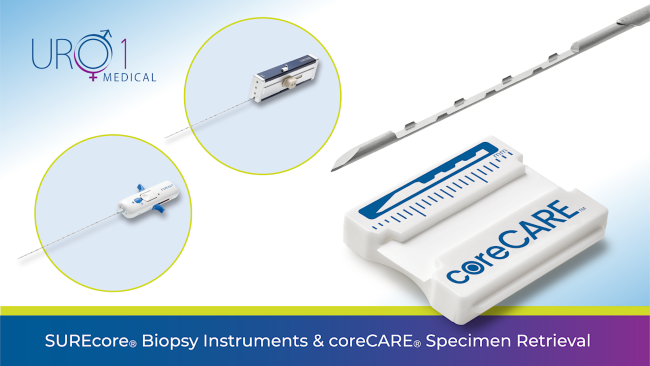
“SUREcore offers a tremendous advantage for us which ultimately benefits the patient because we’re seeing more tissue per biopsy,” Dr. Cohen said.
The response from other pathologists and histology technicians has been quite positive, he added.
Multi-center study already promising
Ted Belleza, URO-1 president and CEO, said a study involving SUREcore and coreCARE validated that the biopsy system provides larger specimens with less fragmentation and tortuosity, or deviation from a straight line.
More importantly, use of the SUREcore/coreCARE platform was associated with a decrease in the diagnosis of Atypical Small Acinar Proliferation (ASAP). ASAP is a diagnostic category created for those instances when a pathologist is unable to confidently determine whether or not the tissue is malignant. Per standard of care guidelines, men diagnosed with ASAP return for repeat biopsies 3-6 months after the first.
Belleza said that an interim analysis of 75 patients enrolled so far in a URO-1 multi-center study is “extremely promising,” and that the study appears to be replicating results of the company’s pilot studies regarding tissue length, tissue volume and surface area, and prostate cancer detection.
The study will continue enrolling participants until it reaches 200.
Other updates from URO-1
Duke University Hospital is one of four study sites in the ongoing multicenter study, Belleza said. The University of North Carolina at Chapel Hill’s Lineberger Comprehensive Cancer Center pathology services is digitizing the biopsy slides for AI analysis. URO-1 provided UNC with a grant for the analysis.
Additional clinical evaluations are pending in three more Novant facilities in N.C. and at WakeMed Health & Hospitals.
“Our goal is to be the market leader in prostate biopsy devices in our home state of North Carolina,” Belleza said. “Also, on Jan. 20, the US Patent & Trade Office issued URO-1 a patent for a more accurate needle that provides even better target accuracy than our standard needle.”
The company plans to launch its products for Interventional Radiology in April at the annual meeting of the Society for Interventional Radiology and collaborates with the University of California, Davis and the University of Washington to develop a new system for breast biopsy.
URO-1 has set up manufacturing in its Greensboro facility and collaborates with CATHTEK, a Winston-Salem contract manufacturing company, to produce its products.
The North Carolina Biotechnology Center provided a $250,000 Small Business Research Loan to URO-1 in 2018.
Kathy Meserve, senior director of investments at NCBiotech, has been an ongoing advocate for URO-1.
"Ted and his team at URO-1 have put years of thoughtful work into their SUREcore and coreCARE platforms," Meserve said. "This is significantly improving the prostate biopsy patient experience and is providing clearer results that better inform clinician decision making. I'm very pleased to learn about the strong traction they are obtaining within our health systems."
URO-1 secured a round of equity financing in 2025. GenHenn Capital, a single-family office investor in life sciences companies, led that financing round. The financing adds to a Series A round of $8 million announced in early 2024.
Related Articles:
Novant adds URO-1 to vendor list, begins enrollment in trial | North Carolina Biotechnology Center