

NCBioImpact celebrates 25 successful years with industry resource fair
Strong partnerships and innovative collaborations have fueled North Carolina’s life sciences success since the mid-1980s. The emerging industry’s workforce education and training needs have been expanding and evolving ever since.
NCBioImpact, a public/private partnership created to bring together key resources to produce world-class biopharma manufacturing training programs, organized a unique event to enhance communication and information-sharing around workforce training and development.
The inaugural Industry Resource Fair was held on April 8 at the North Carolina Biotechnology Center. It attracted more than 125 attendees from NCBioImpact partner organizations in education, workforce and industry, all eager to share information and learn more about how best to support the life sciences industry.
To encourage connections, breakout “zones” were located on NCBiotech’s first and second floors, and Resource Fair exhibits were divided into four zones: STEM Outreach, Continuing Education, Degree Programs and Analytical Programs. Panel sessions were held in the auditorium, with networking breaks scheduled between sessions.
‘Making a true impact’
NCBioImpact President Laura Gunter welcomed attendees. In addition to being the organization’s first-ever resource fair, she said, the special event marked NCBioImpact’s first 25 years.
During that time, NCBioImpact has "grown and expanded partnerships and created a model for specialized workforce development," Gunter said. “Hundreds of people have undertaken new careers that are making a true impact on the industry and the world,” she added.

NCBioImpact partners include the North Carolina Life Sciences Organization (NCLifeSci), NCBiotech, the University of North Carolina and the North Carolina Community College system.
Support also comes from the North Carolina Department of Commerce, Golden LEAF Foundation, the National Institute for Innovation in Biopharmaceuticals and the National Center for Biotechnology Workforce.
Bill Bullock, NCBiotech’s senior vice president of economic and statewide development, also welcomed the group and echoed Gunter’s emphasis on partnerships and collaboration. “Historically, when it comes to workforce, we know that when you bring good people together, great things happen,” Bullock said. “It is truly inspiring to see the commitment, connectivity and engagement of everyone here today. Partnership is the lifeblood of what we do at NCBiotech.”
Developing new workforce models
Bill Monteith, NCLifeSci’s biomanufacturing program manager, emceed the event. He recalled the biotechnology industry’s workforce issues in the 1990s and early 2000s, when “we were basically competing for the same employees,” he said, with no long-term, strategic workforce development plan.
He also heard some companies had difficulty finding employees with the education and skills needed to carry out complex procedures and maintain the strict regulatory standards required for biopharmaceutical manufacturing.
It was clear: North Carolina’s life sciences needed a new workforce development model. To meet that need, NCBiotech spearheaded the 1st Strategy for Life Sciences, published in 2004. In 2008, a two-year “Window on the Workplace” report was released outlining successes and challenges in North Carolina’s life sciences industry and workforce. Those reports continue to be published biannually.
Declining traditional industries
Meanwhile, North Carolina’s traditional manufacturing industries of textiles, furniture and tobacco were declining. On July 30, 2003, Pillowtex, a textile manufacturer, announced bankruptcy and 4,000 people employed onsite in Kannapolis and Rowan County lost their jobs overnight—still the state’s largest layoff ever.
A few years earlier, the state’s tobacco industry was hit with a large financial settlement: The National Association of State Attorneys General announced in 1998 that, “52 state and territory attorneys general signed the Master Settlement Agreement (MSA) with the four largest tobacco companies in the U.S. to settle dozens of state lawsuits brought to recover billions of dollars in health care costs associated with treating smoking-related illnesses.” The settlement cost the companies $206 million and severely curtailed promotional activities, resulting in lower sales and state revenue.
North Carolina now had thousands of people needing new jobs, education and training—an expensive proposition—and an emerging growth industry that needed skilled workers. Enter a new partner and, it turns out, a vital source of critical life sciences industry funding.
Funding education and training via tobacco funds
The nonprofit Golden LEAF Foundation was established in 1999 to receive North Carolina’s portion of the $206 million MSA. Using those funds, the Golden LEAF Foundation’s Board of Directors in 2003 made a bold decision to grant nearly $70 million to NCBioImpact to jumpstart workforce development programs to support displaced tobacco and other workers in rural areas.
Twenty years later, the magic of North Carolina’s collaborative model resulted in another major funding success: a $25 million Phase 2 award from the U.S. Economic Development Administration’s Build Back Better Regional Challenge. Funding for the Accelerate NC-Life Sciences Manufacturing coalition will increase awareness of, access to, and availability of life sciences manufacturing training across 79 of 100 North Carolina counties.
Creating new consortia, greater diversity
The EDA funding created three key workforce groups:
- BioBetter Consortium, a coalition of 10 community colleges led by the NC Community College System's BioNetwork, has expanded entry-level life sciences manufacturing training. It includes the BioWork certificate program, a 136-hour course that teaches foundational skills to begin a career as a process technician in life sciences manufacturing.
- Historically Black Colleges & Universities/Historically American Indian Colleges Coalition, led by the Biomanufacturing Research Institute and Technology Enterprise (BRITE) at North Carolina Central University. Other HBCU/HAIC participating institutions are the University of North Carolina at Pembroke, Fayetteville State University, Saint Augustine’s University, Livingstone College and Winston-Salem State University.
- Community Engagement, led by NCBiotech. The funding supports several projects to increase North Carolinians’ awareness of life sciences careers and attract workers ranging from high school graduates through degree-seekers and career-changers, including veterans.
Evaluating workforce impact
With all the new education and training programs available after 25 years, what kind of impact have they had on workforce education and development? Several speakers addressed the question.
John Balchunas, workforce director for the National Institute for Innovation in Manufacturing Biopharmaceuticals, attended South Carolina BIO’s annual meeting in February. During a panel discussion on site selection for life sciences companies, Balchunas said, “North Carolina kept coming up and panel members sang the state’s praises,” in large part because of the state’s “40-year headstart” in industry recruitment and workforce development. NCBiotech was created in 1984, with NCBIO (now NCLifeSci) following 10 years later.
The numbers tell a compelling story, said Laura Rowley, Ph.D., NCBiotech’s vice president of life sciences economic development. There are now 860 life sciences companies in the state employing nearly 96,000 workers. And instead of being concentrated only in the Research Triangle area, they are spread out from Asheville and the Triad through Greenville and Wilmington. The main sectors are clinical research organizations, biomanufacturing and research and development (R&D).
“We have so much to be proud of,” Rowley added, “but we can’t rest on our laurels. We need a fabric to connect people to clear, tangible pathways so that no matter where they are, they can find fulfilling careers in the life sciences.”
Collaborating for GMP training
The second panel discussion, “University Collaboration for GMP Manufacturing,” featured university life sciences educators involved with introducing students to Good Manufacturing Practices. GMP, overseen by the U.S. Food and Drug Administration, requires workers to understand and carry out complex processes and adhere to strict regulatory requirements to ensure product safety in life science manufacturing.
Life sciences educators shared their abundant resources, expansion initiatives, collaboration and success strategies for connecting graduates with roles. All contribute to a career-based learning continuum, speakers agreed.
Recruiting the next generation
During the third panel of the day, “Community College Programs: How Connecting Can Fuel Your Pipeline,” speakers and attendees discussed how best to fill ALL the jobs needed for a thriving life sciences ecosystem.
“We must be able to find the people who match the jobs, and they’re not just in degree programs,” said Monteith, the event’s emcee and director of NCLifeSci’s biomanufacturing program.
Prospective employees might, for example, complete community college continuing-education classes to become machinists or electricians, or complete a two-year Associate’s degree in Applied Science (AAS) to prepare for rapid entry into the workforce in specific industries. Several universities have AAS-to-B.A. or B.S. programs. North Carolina Central University and Alamance Community College, for example, collaborate to offer such programs.
Raising awareness among younger students
Campus, industry and nonprofit outreach programs connect with thousands of North Carolina high school students each year. Activities range from classroom and biopharma-related field trips to hearing directly from an industry representative. Internships and apprentice programs also offer vitally important opportunities to demystify the life sciences industry.
Miguel Hernandez, director of quality systems at Pfizer Inc. in Sanford, is sold on the value of internship programs. He was only 16 when he started as an intern at Pfizer; he’s been there for 23 years. “The internship is why I’ve stayed so long,” he said. “I knew it was the right path for me.”
Apprenticeships also can be useful, several company representatives said. The North Carolina Life Sciences Apprenticeship Consortium, composed of life sciences companies, seeks to build the state’s talent pipeline and collaborate with academic institutions and nonprofit organizations to build awareness of and access to training and career opportunities in the life sciences. Once students have completed a community college’s BioWork certificate program, they may apply for an apprenticeship with one of the participating companies.
Honoring NCBioImpact founders
The final session paid tribute to NCBioImpact’s founding organizations. On stage were current or former principals themselves or institution representatives:
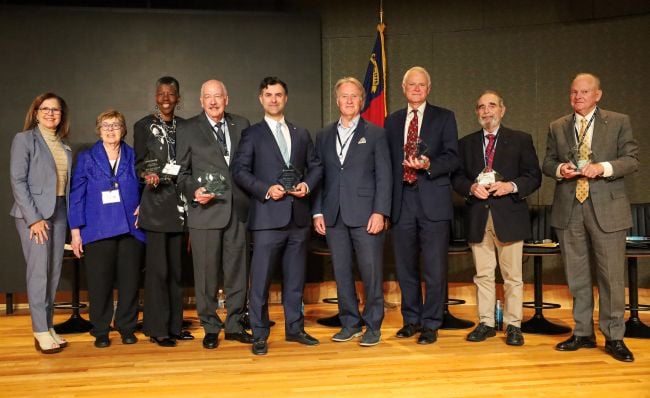
- Hal Price, Biogen general manager, 1995-2003. Price, an industry consultant and biomanufacturing workforce development pioneer, lives in Wilmington. “I could hardly believe my eyes as I drove here today,” he said. “I was shocked and amazed at what has transpired here.” Biogen had 300 employees when he started; today, it has 1,500, “and they’re continuing to get more!” he added.
- Ruben Carbonell, Ph.D., Frank Hawkins Kenan Distinguished Professor of Chemical and Biomolecular Engineering at North Carolina State University and former executive director of BTEC. He was instrumental in launching the National Institute for Innovation in Manufacturing Biopharmaceuticals (NIIMBL), where he serves as senior technology strategist.
- Sam Taylor, founder and long-time president of NCLifeSci (posthumous award). Brenda Summers, a nonprofit and small business consultant and former staff member at NCLifeSci, worked closely with Taylor. “Sam wrote the Golden LEAF Foundation grant application,” to obtain funding from the tobacco settlement to support NCBioImpact, Summers said. He later “got industry members together to go to the Legislature” for ongoing NCLifeSci funding, she added. Taylor died of pancreatic cancer in 2021. The Samuel M. Taylor Life Sciences Memorial Scholarship, set up through the NC Community Colleges System, was created to honor his outstanding work in North Carolina’s life sciences industry and support students seeking a life sciences career.
- Kathleen Kennedy, Ph.D., NCBiotech, director, biotechnology training program (posthumous award). Ken Tindall, Ph.D., retired NCBiotech senior vice president for science and business development, talked about Kennedy’s pivotal role in linking education and training. “Partnering and collaboration were in her DNA,” he said.
- Lawrence Davenport, North Carolina Golden LEAF Foundation. Scott Hamilton, president of Golden LEAF, read a letter from Lawrence Davenport, who led the foundation for 25 years. Through the tobacco settlement money, Davenport said, “We set the stage for dramatic growth in the life sciences industry.”
- Mark Sorrells, Golden LEAF Foundation. Sorrells, a former senior staff member at Golden LEAF. “This state has performed miraculously in life sciences,” he said. “No other state could come together in such collaboration.”
- Gov. Mike Easley. Represented by his son, Mike Easley Jr., discussed how difficult economic times were for North Carolina’s manufacturing companies and the workforce. “My father recognized the importance of supporting life sciences to ensure everyone who needed a job would have the resources to acquire one,” he said.
- Rosalind Fuse-Hall, North Carolina Central University. Fuse-Hall thanked the life science industry for supporting NCCU. “Those were early, early days,” she said, of when the Golden LEAF money came to the university to fund BRITE. “We didn’t have any graduate programs in life sciences, but we knew all the components were there and we had great confidence we were the right people ‘in the room.’”
NCLifeSci Workforce and Partnerships Administrator and NCBioImpact Administrator Jenae Williams came up to the stage to present one final award: to Brenda Summers, for her outstanding service to the life sciences industry, NCLifeSci and NCBioImpact.
“This has been a great day,” Williams said.
----
One final note, from Janae Williams, posted April 9 on LinkedIn:
“My past and present converged in a powerful and meaningful way on Wednesday. 30 years ago, being green and wet behind the ears, I wrote a letter to Biogen’s general manager, Hal Price, from Penn State,” she said. She was hired to be part of the start-up team for Biogen’s commercial biotech manufacturing facility in Sanford, one of the first in North Carolina.
“This past Wednesday, I got a chance to reunite with and honor Hal and several visionary leaders who worked with former governors Jim Hunt and Mike Easley to build an infrastructure … to create a pipeline of talent for the Biomanufacturing landscape that we know today. … Preparing for the day was a labor of love and seeing these pioneers together was simply a moment I will never forget.”