

AI, biotech, and federal investment a generational opportunity for NC’s research universities
AI has only just begun to reshape the drug discovery landscape, but it is doing so in a landscape rife with volatility, skepticism, and shifting expectations. In this rapidly evolving sector, leadership will be defined by the ability to cultivate exceptional talent and navigate systemic constraints to connect research, capital, and translation. This is not possible without a steadfast commitment from our partners in the federal government and private industry.
It’s important to acknowledge and evaluate the current constraints. On the research side, AI systems trained for drug discovery are restricted by their training data and by the skills and foresight of people who design, validate, and deploy the systems. The biotech funding environment is also limited, with venture capital investment at its lowest point since 2021. Fewer early-stage deals are happening, and there is a higher bar for translational readiness.
Although AI-driven drug discovery is accelerating key stages of development, pharmaceutical companies are increasingly focused on later-stage assets. As risk aversion and opportunity continue to pull in opposite directions, narrowing this gap will be critical to success.
NC Research Universities as innovation engines
This unpredictable environment offers both opportunity and risk for large research universities such as UNC-Chapel Hill, Duke, and NC State. While North Carolina and the Research Triangle Park are well positioned to capitalize on emerging opportunities that can propel our region to even greater heights, success will depend on continued strategic investments.
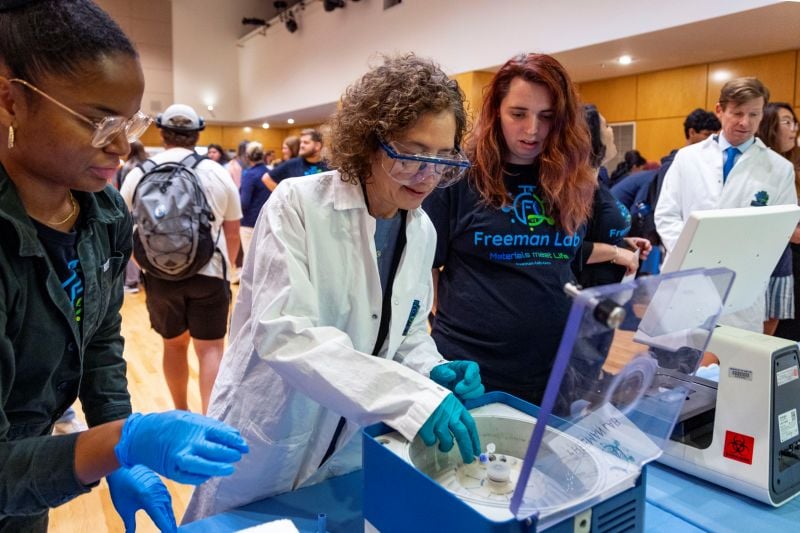
Universities are innovation engines. Federally funded university research ecosystems have long generated the discoveries and stability that attract private-sector investment, which has propelled North Carolina into becoming one of the nation’s most vibrant biotech regions. Bolstered by policies such as the Bayh-Dole Act (1980), which enables universities to commercialize federally funded research, universities are incentivized to commercialize their discoveries, creating the commercial pipeline that has built the modern biotech industry.
In addition to sustained federal investment, universities have long been rich with talent and specialized infrastructure and equipment, as well as access to high-quality data assets. This unique proposition, backed by a legacy of high-impact collaborations, will shape the future of AI-driven discovery. The most successful entities in this space will pair strong computational capability with deep, scientific expertise from researchers who know which questions matter, which data to trust, and which results demand skepticism.
In this vibrant ecosystem, consistent federal funding awarded to universities is a critical catalyst for supporting the drug discovery pipeline. This includes National Institutes of Health (NIH) R01 grants that support foundational discovery science; federal SBIR/STTR early commercial bridge funding; Advanced Research Projects Agency for Health (ARPA-H) high-risk, high-reward translational programs; and more.
Federal funding is critical for discovery, validating early hypotheses, and building datasets and platforms, all of which provide the critical substrate for commercialization. Federal investment is also critical for attracting follow-on venture capital and pharmaceutical partnerships that enable translation of near-market opportunities into commercial outputs.
Successes across RTP, NC
When we get this right, amazing things happen. Take the example of Jude Samulski and AskBio, which began with state and institutional investment in a single investigator who was pursuing gene therapy at a time when the field had no proven commercial track record. State and federal investments, along with steadfast support from the North Carolina Biotechnology Center, helped seed an industry that now anchors one of the most robust life science ecosystems in the country.
Ultimately, AskBio produced a Pfizer acquisition of spinoff Bamboo Therapeutics, a $245 million venture capital round, a $4 billion acquisition by Bayer AG, and manufacturing facilities employing hundreds of workers in rural North Carolina communities that previously had little connection to the biotech industry. Samulski spent 25 years building the science that underlies every FDA-approved adeno-associated virus gene therapy in existence.
Across the Research Triangle, researchers are working to create similar success stories with AI. However, we face significant uncertainty in federal funding, including budget pressures, shifting priorities, and increased scrutiny of indirect costs. These barriers have slowed the innovation pipeline and led to talent leakage from universities to the private sector or overseas. The risks are greatest for regions like ours, which have been the beneficiaries of a rich research ecosystem that has historically driven economic development.
Universities are workforce engines, startup incubators, and regional economic anchors, with every federal dollar translating to substantial downstream economic development. For example, in fiscal year 2025, UNC-Chapel Hill research supported 24,087 jobs and generated $2.9 billion in value to the state GDP. In addition, reporting by United for Medical Research reveals that UNC-Chapel Hill’s $514 million in annual funding from the NIH alone delivers a $1.32 billion impact on the state’s economy and creates nearly 5,000 jobs.
Convergence of AI, biotech, federal investment
Research universities are adapting to current challenges by diversifying funding sources, growing commercialization efforts, and developing university-affiliated incubators and accelerators. There is a large volume of licensable technologies created by these efforts, signaling a buyer’s market for innovative IP. This is when strategic early engagement with universities has potential for significant payoffs in the form of better deal terms and more meaningful engagement, especially on AI-driven discovery.
North Carolina has a compelling story to tell. With world-class universities, a biotech workforce ranked among the nation’s top 10, and a well-established life sciences cluster, the state is exceptionally well positioned for continued growth. Now is the time for policymakers to sustain and expand federal investment in university research while preserving innovation-friendly funding structures.
At the same time, North Carolina must develop a clear strategy for a data-intensive future, ensuring access to the computing and quantum capabilities needed to fully leverage our research assets, talent, and partnerships.
Universities must continue accelerating translation and collaboration. The convergence of AI, biotech, and federal investment represents a generational opportunity. North Carolina stands ready, but continued leadership in this arena depends on a results-oriented strategy of intentional investment and forward-looking collaboration.
About the author:
Penny Gordon-Larsen, Ph.D., is vice chancellor for research at the University of North Carolina at Chapel Hill. She is the W. R. Kenan, Jr. Distinguished Professor in Nutrition and has been a Carolina faculty member since 2002. Gordon-Larsen is also a member of the North Carolina Biotechnology Center's Board of Directors. See her full biography.