

Humabiologics to expand in Winston-Salem's Innovation Quarter
Six months after launching research-grade human collagen, Phoenix-based Humabiologics announced its first expansion, to Winston-Salem’s Innovation Quarter, on Nov. 12.
The company will use the Innovation Quarter site to accelerate development and manufacturing of first-in-market medical devices made from native human collagen, establish a new base for clinical collaboration, device innovation and manufacturing growth, the announcement said. The company’s base will remain in Phoenix.
“We are very excited for our first expansion to be in the heart and soul of regenerative medicine,” Humabiologics Founder and CEO Mohammad Albanna said in an interview. “We knew it would be the right environment from Day One.”

Albanna knows that environment well. He was appointed adjunct assistant professor of surgery in the Wake Forest School of Medicine in 2014. He managed the product innovation portfolio of medical devices at Wake Forest Innovations, which oversees intellectual property for the Atrium Wake Forest Health System and Wake Forest University, from 2014 to 2015.
Earlier, he did part of his training in Winston-Salem as a team leader and research scientist at Atrium Health Wake Forest Baptist’s Wake Forest Institute for Regenerative Medicine (WFIRM). WFIRM, part of the medical school, is in the Innovation Quarter.
Researching collagen applications
Collagen, the most prolific protein in the human body, was a natural place to begin Humabiologic’s research journey. The company works with highly regulated tissue banks to receive unused donor tissue, extract and purify the collagen, and provide it to researchers in the U.S., Europe and Asia.
Those researchers, in turn, are focused on how human-derived collagen can be applied to human needs. Applications range from wound care and burn treatment to cancer and heart disease, as well as drug development.
WFIRM Director and regenerative medicine pioneer Dr. Anthony Atala said in the announcement, "Humabiologics is helping shape the next generation of regenerative technologies by using native human biomaterials to bridge the gap between research and patient care.”
For Albanna and his team, facilitating translation between research and patient care by providing high-quality, human-derived products such as collagen is meaningful and important. He takes special care to acknowledge the generosity of tissue donors who make the work possible.
“We started in January 2020, when the whole world was shutting down [due to COVID],” he said. “It was stressful, but we know that even on the most stressful day, our work has an important impact.”
The company is a key partner of the Regenerative Medicine Engine, an initiative funded by the National Science Foundation to advance North Carolina's regenerative medicine ecosystem. Humabiologics received a RegenMed Engine's $2.5M Ecosystem Development Award grant in 2024.
The engine aims, “to cultivate breakthroughs in healthcare by providing the resources necessary to accelerate the transition of use-inspired regenerative medicine technologies into commercial products,” according to the NSF website. NCBiotech is an Engine Ecosystem Partner.
Deciding to expand in Winston-Salem
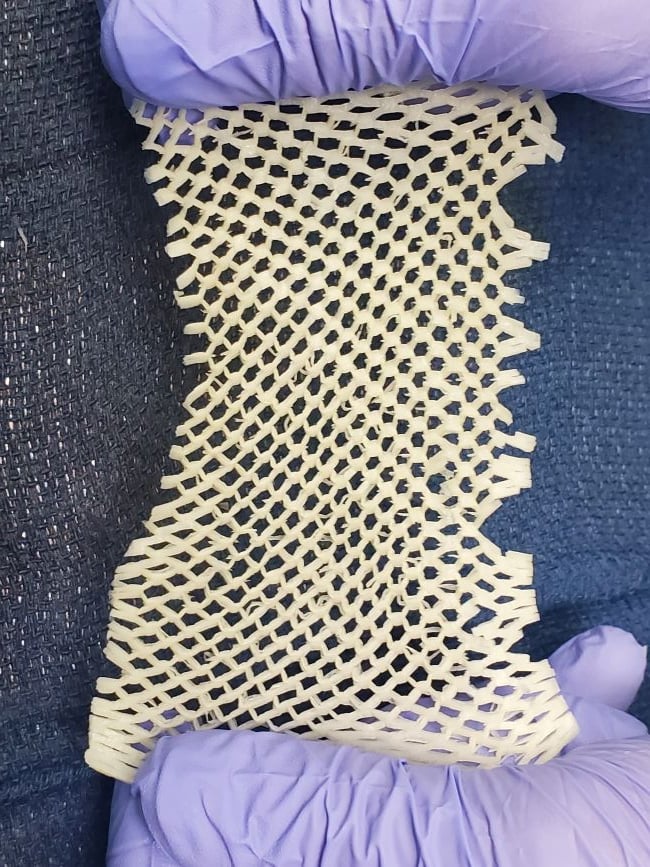
Humabiologics began with a mission to provide the first clinically relevant, human-derived materials for regenerative medicine research. After years of building a strong foundation in quality systems and tissue-based biomaterial innovation, the company is extending its impact beyond research, translating its technology to serve patients directly.
"Today, we are taking the next step, developing medical devices from the same human collagen that has already helped patients for decades through donated human tissue," Albanna said in the announcement.
He noted the Winston-Salem site will focus on collaborative product development, clinical translation and early-stage manufacturing in partnership with regional institutions, including WFIRM. The location is close to healthcare systems and offers the specialized workforce pipeline needed for future scale-up.
By leveraging its unique tissue donation history and advanced collagen technology, Humabiologics seeks to co-develop innovative regenerative therapies with leading medical device companies, the announcement added.
Humabiologics is now hiring its first Triad-based employees and expects to expand its local team over the coming year, Albanna said.
"We're not leaving Phoenix; we're growing," Albanna added. "The Innovation Quarter offers an ideal environment where science, collaboration and economic development come together, exactly the kind of community where transformative medical innovation belongs."