

Johnson & Johnson symposium: AI bringing both opportunity and risk in drug development
As artificial intelligence begins to play a more central role in drug discovery, how do researchers and scientists achieve the right mix of AI-driven insights, data integrity, human involvement and ethical considerations?
That rather large question hanging over the life sciences industry took center stage at a recent symposium presented by Johnson & Johnson at the North Carolina Biotechnology Center. It’s an issue that everyone involved in the therapeutic pipeline needs to confront, even if it’s too early for clear answers to emerge, speakers at the daylong symposium said.
“Every biologist should be learning to write fundamental code and interface with AI if they aren’t right now,” Emma Chory, a Duke University assistant professor of biomedical engineering, said during a panel discussion titled “Drug Hunting in the Age of AI.”
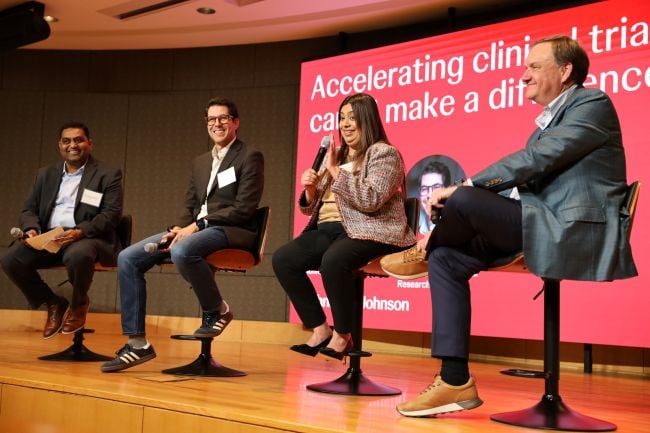
Marcel Frenkel, CEO of Durham startup Ten63 Therapeutics, also noted the potential for AI combined with human knowledge to improve and accelerate drug discovery. Succeeding as an AI therapeutics company means doubling down on scientific talent, not turning over critical skills to large language models, he said.
“You need great biologists, great chemists, you need drug hunters, people that understand what the problem is,” said Frenkel, whose company develops therapeutics using generative AI with physics-based models. “You’ve got to put them in positions of leadership as well so that they can push back against the platform. They can tell you, ‘Hey, this is not doing what I need to develop this program.’”
Weighing AI and patients in clinical trials
Advanced use of data and increasing reliance on AI are touching all phases of therapeutic development. Case in point: As therapies progress to clinical trials, a large disconnect emerges between AI capabilities and human involvement, according to Eric Perakslis, chief science and data officer at Pluto Health. Pluto is a Durham company that connects fragmented health data to improve patient care through the use of AI-driven clinical intelligence.
“There are more models, there’s more data, there are more ways to go about modeling things and bringing things together” through AI and other technology, Perakslis said in his keynote presentation. “You’re actually seeing the opposite on the human side. The [trial] criteria are getting more and more strict. Guess what? You don’t have the variant, you don’t get to be in the trial.”
Instead of using AI to develop models that exclude patients based on restrictive criteria, it should be used to help predict which patients should be included and could benefit from participation, he said.
Panelists discussing AI in clinical trials agreed.
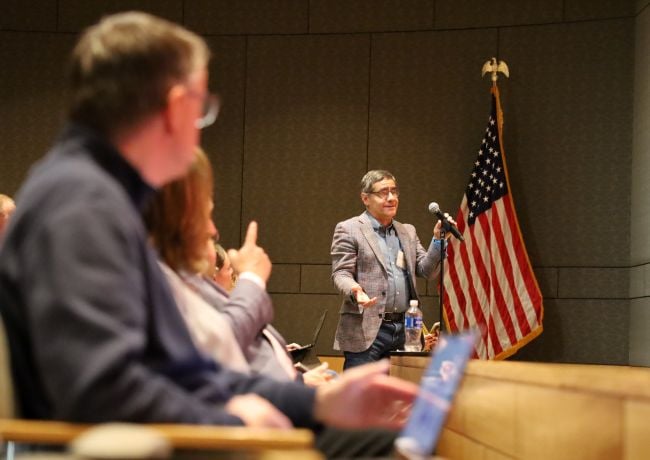
“If the hemoglobin is 0.1 below what you need for the inclusion criteria, and you’re excluding that otherwise perfect participant for the trial, that’s not right,” said Micky Cohen-Wolkowiez, executive director of the iCubed: DCRI Innovation Center at the Duke Clinical Research Institute.
Added Sheetal Telang, vice president of therapeutics strategy at IQVIA: “For me, the proof in the pudding is if clinical research becomes a clinical care option, that would reduce healthcare burden tremendously. And I think AI plays a huge role in that and can play a huge role in that in the future.”
AI in biopharma manufacturing
With North Carolina’s growing strength in biopharma manufacturing, the use of AI by drugmakers will be watched closely for examples of process improvements, efficiency gains and employee adoption.
At Biogen, which in July announced an additional investment of $2 billion in its Research Triangle Park operations, the company has launched cross-functional discussions of AI adoption and use cases, said Sarwat Khattak, head of cell culture and cell line development in RTP for the Cambridge, Mass.-based biotech.
One example she cited was that of an engineer who used Microsoft Copilot for coding in Python to optimize a model. A job that previously would have taken between six and eight weeks was completed in just two weeks, she said.
Likewise, at FUJIFILM Biotechnologies, AI is proving valuable to help speed processes, said Dan Hill, director of process analytics. The company opened its new $3.2 billion biomanufacturing site in Holly Springs in September.
“It allows us to predict how a process behaves in small-scale development to get us into a large-scale facility much faster, with higher success rates,” he said.
Startups leaning into AI and data
The symposium concluded with five life sciences and healthcare startups describing their companies in short presentations. One company, Translational Imaging Innovations, has developed an imaging platform to organize and integrate data for research and trials in ophthalmology.
“The problem we’re focused on is breaking down the silos and building the workflows so that we can put AI and data science together with images…to get effective imaging biomarkers that could be useful in drug development,” said Eric Buckland, founder and CEO of the company, which received a $250,000 award from NCBiotech in 2023.
About Johnson & Johnson
Johnson & Johnson’s external innovation group works across the innovative medicine and medical technology sectors to accelerate early-stage, transformational solutions by catalyzing the most promising ideas, wherever they are in the world. We do this by harnessing our deep scientific capabilities coupled with a wide range of tools, including customized deal structures, company creation, incubation and startup services, capital investments and other innovative business models that aim to meet the diverse needs of entrepreneurs, scientists, and emerging companies. Our goal is to help life science and health technology innovations thrive through collaboration and partnership with the global ecosystem, so that together we can change the trajectory of human health. Meet our passionate team of science and technology experts and learn how to collaborate with us at www.jnjinnovation.com.