

Automation, partnerships driving advances in NC pharma manufacturing
With roughly 35,000 people employed in life sciences manufacturing, North Carolina has emerged as one of the leading destinations for biopharma companies building or expanding their operations.
It’s no surprise, then, that the state’s biopharma manufacturers are investing heavily in technology, partnerships and people to maintain their competitive edge. That focus was front and center during the recent collaboration with INTERPHEX, the North Carolina Biotechnology Center and FUJIFILM Biotechnologies.
“I’m excited about the impact we’re having in North Carolina and what we’re doing here to establish ourselves as the area to compete with in the U.S.,” said Laurie Braxton, senior vice president and site leader of North Carolina operations for FUJIFILM Biotechnologies. “We’re not just giving people jobs for a few days or a few years. We’re creating career paths that are going to allow people to excel in something that they’re passionate about.”
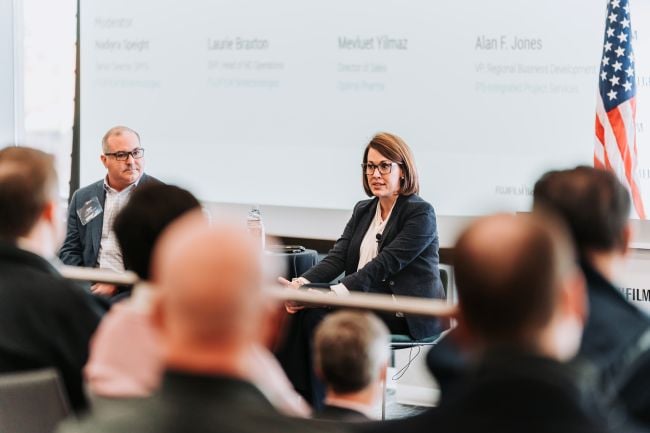
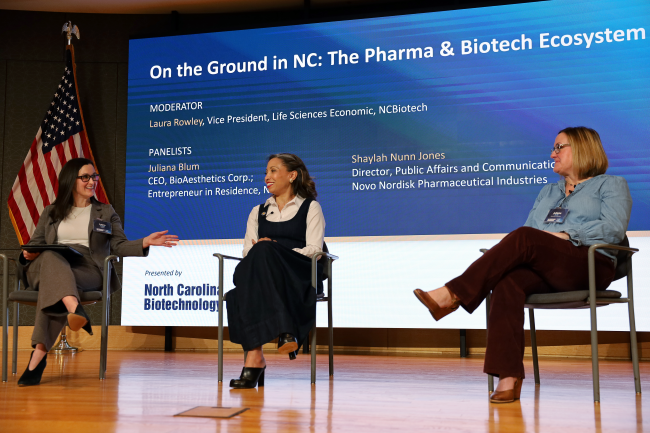
Braxton was speaking at a recent daylong event on North Carolina life sciences manufacturing called “INTERPHEX On the Ground – North Carolina: The Inaugural Immersive Experience for Pharma and Biotech Professionals.”
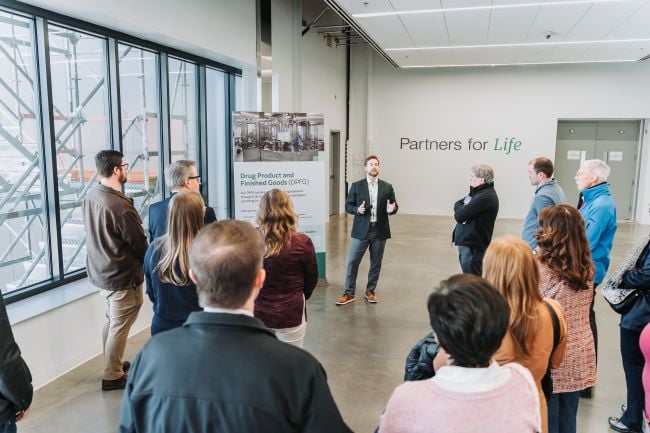
The experience was organized by INTERPHEX, a pharma and biotech event held annually in New York City (April 21-23, 2026). INTERPHEX On the Ground was co-hosted by FUJIFILM Biotechnologies, a leading global contract development and manufacturing organization and NCBiotech. The day included panel discussions and networking opportunities at NCBiotech’s Research Triangle Park conference center and a panel and facility tour at FUJIFILM Biotechnologies’ new cell culture manufacturing facility in Holly Springs.
Technology assisting, not replacing people
Life sciences leaders provided insights into the ways their companies are building smarter, more advanced manufacturing capabilities.
Advances in automation and artificial intelligence are helping manufacturers speed production of medicines while reducing error rates and downtime. While AI plays a key role, it doesn’t work without people and processes, Matt Foster, Research Triangle Park site head at Eli Lilly, said during a panel discussion on the role of automation in therapeutic innovation.
“I think AI is in combination with HI – human intelligence – in a partnership, not just an outsource,” he said. “You have got to understand principles first to trust the AI tool or application that’s going to benefit you and make you better.”
One application of AI that’s improving drug manufacturing is the use of digital twins to simulate production processes and facilities. Joash Mudalige, vice president and site head for Genentech’s 700,000-square-foot manufacturing facility under construction in Holly Springs, said the company is using digital twins to design facilities with a high degree of precision.
“We have the entire model of the plant built on a digital twin, down to the varying temperature in the warehouse,” he said. “What you can do through a tool like a digital twin, going into the design phase now, is just incredible.”
Collaboration over competition
The role of partnerships in biopharma manufacturing also took center stage during the day. Developing relationships across the industry is especially critical for contract development and manufacturing organizations (CDMOs) such as FUJIFILM Biotechnologies, which provides drug development and manufacturing services to pharmaceutical companies.
FUJIFILM Biotechnologies’ Braxton said the growing presence of manufacturing facilities in North Carolina is contributing to an environment marked more by collaboration than competition.
“What we’ve had a lot of conversations about is, how do we not compete against each other, but how do we actually learn from each other, and how do we spread and share the wealth?” she said.
One way to foster collaboration, several speakers said, is to join forces in support of education and training programs through the state’s universities, community colleges and corporate training centers.
Mevluet Yilmaz, director of sales for Optima Pharma, a German-owned company with a pharmaceutical filling and packaging operation in Knightdale, said workforce training is an area requiring significant investment on the part of pharma manufacturers.
“Having trained operators that can operate the equipment is really key,” he said. “Having a solid training program can really help them to understand and feel comfortable touching the equipment.”