

ARPA-H funds WFIRM-led program for on-demand bioprinted kidneys
A new 5-year federal award of up to $24.8 million to the Wake Forest Institute for Regenerative Medicine (WFIRM) will help address the nation’s growing organ donor shortage by bioprinting on-demand kidney tissues.
The new funding, from the Advanced Research Projects Agency for Health (ARPA-H), will enable WFIRM to produce bioprinted, vascularized kidney tissue that augments renal function in patients suffering from kidney disease. The implantable kidney tissue will be made from a patient’s own cells combined with a bioink that supports the long-term viability of the implanted cells.
“This project demonstrates how tissue engineering can be coupled with bioprinting to create a positive disruption to the health and well-being of patients by providing an inexhaustible pipeline of autologous tissues and organs,” said Anthony Atala, M.D., principal investigator and director of WFIRM. “We look forward to collaborating with ARPA-H and our project’s partners to further develop bioprinted tissues and organs.”
The funding comes from the Personalized Regenerative Immunocompetent Nanotechnology Tissue (PRINT) program at ARPA-H, an agency within the U.S. Department of Health and Human Services. The PRINT program aims to use the latest technologies in bioprinting and regenerative medicine to quickly create personalized, on-demand organs.
“Our project will integrate a variety of processes and technologies, including cell manufacturing, bioprinters and bioinks, and bioreactors, into an end-to-end workflow that produces clinical-grade, functional kidney tissue comprised of all major renal cell types,” said James Yoo, M.D., co-principal investigator and chief operations program officer at WFIRM.
A national need
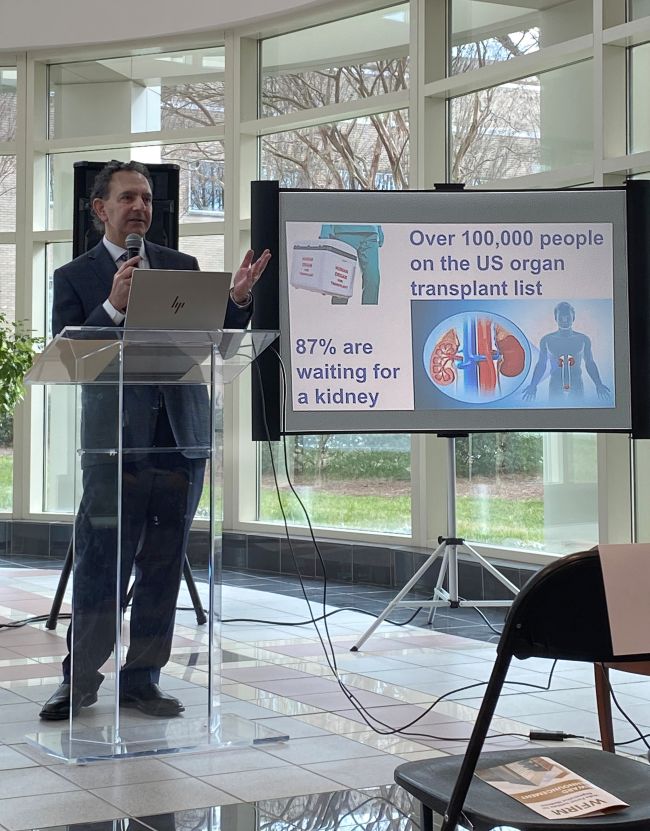
The program aims to solve the critical problems of organ shortage and transplantation risks in the United States. There are 120,000 people on waiting lists for an organ, but only 45,000 transplants are performed annually. In addition, transplanted organs only last about 15 to 23 years on average and require immunosuppressive drugs for life.
“What we are trying to do with PRINT is extraordinarily hard. It requires major breakthroughs in cell manufacturing, bioreactor design, and 3D printing technology to reliably build organs that function like the real thing,” said PRINT Program Manager Ryan Spitler, PhD. “But if we succeed, we won’t just be giving patients faster access to new organs. We will change the foundation of transplantation itself. The advances from this program could dramatically reduce wait times, eliminate the need for lifelong immunosuppressive drugs, and open the door to bioprinted solutions for many other organs in the future.”
A regenerative medicine leader
WFIRM will also create a manufacturing and commercialization plan to ensure the scalability of bioprinting personalized organs and tissues.
Program partners include Dr. John Fisher from the University of Maryland, Dr. Kevin Slawin from PrintBio, Inc., Dr. Thomas Boland from the University of Texas – El Paso, and Dr. Antonios Mikos from Rice University.
WFIRM has more than two decades of experience with a variety of 3D printing techniques to create human tissues and is a leader in developing vascularized tissue constructs.
WFIRM is recognized as an international leader in translating scientific discovery into clinical therapies, with many world firsts, including the development and implantation of the first engineered organ in a patient. Over 500 people at the institute, the largest in the world, work on more than 40 different tissues and organs.
Several of the basic principles of tissue engineering and regenerative medicine were first developed at the institute. WFIRM researchers have successfully engineered replacement tissues and organs in all four categories – flat structures, tubular tissues, hollow organs and solid organs – and 17 different applications of cell/tissue therapy technologies, such as skin, urethras, cartilage, bladders, muscle, kidney, and vaginal organs, have been successfully used in human patients.
WFIRM, which is part of Wake Forest University School of Medicine, is located in the Innovation Quarter in downtown Winston-Salem, N.C.