

Second Annual CRO Summit addresses cost, complexity and collaboration in clinical trials
Innovative approaches to making clinical studies more efficient and cost-effective were a central theme of the 2nd Annual COG: CRO Summit, held in early December in Durham, N.C. The event convened leaders from clinical research organizations (CROs) and functional service providers for two days of networking and open discussion on the future of the industry.
Projected to be worth $150 billion in the early 2030s, the CRO sector is facing higher costs, greater trial complexity and evolving funding models. Sessions highlighted how organizations are responding by embracing AI, refining operational strategies and finding new approaches for site collaboration and patient engagement.
During the welcome address, Jasmina Jankicevic, CMO of Montreal-based Indero, noted the important role of the CRO Summit as a place for CRO professionals to share challenges and solutions while also opening a pathway to new collaborations.
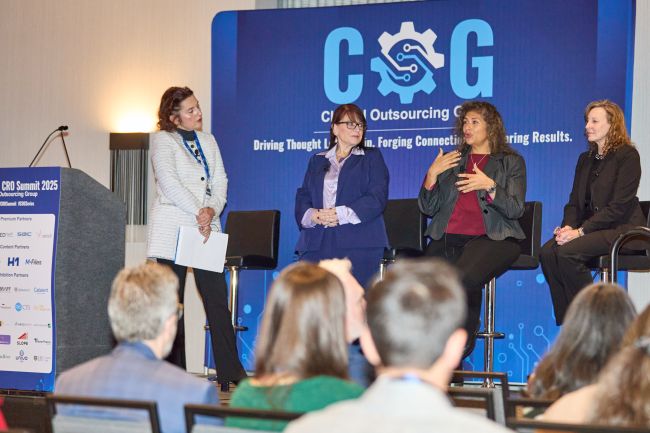
During her talk, Jankicevic spoke about how CROs can accelerate clinical development. She said that it is key to create shorter timelines without compromising the scientific rigor of the study or the safety of patients, emphasizing that accelerating is not the same as rushing.
Finding this balance is harder than ever, with Phase 2 and 3 trials generating upwards of 4 million data points and patient recruitment slowing as therapeutic options expand.
To boost efficiency, Jankicevic said that it is key to simplify protocols by reducing nonessential endpoints, consolidating overlapping assessments and limiting complex exploratory measures that add operational burden. She urged a greater emphasis on adaptive designs, fewer and more flexible study visits, harmonized global protocols and clearer communication with patients.
“I can see a day where the studies are going to be significantly AI-driven, especially from an operational perspective,” Jankicevic said. She also stressed the need to move CRO–sponsor relationships beyond a traditional vendor model toward true strategic partnerships.
Financial outlook
Paul Johnson, executive director of strategy development at PharPoint Research in Durham, shared his perspectives on the growing market pressures for CROs. By 2030, investigator budgets for Phase 2 and 3 trials are projected to increase 40–60 percent, while overall costs per study could rise by as much as 70 percent. In that environment, flexibility becomes essential.
At the same time, the push to control costs while meeting diversity and inclusion requirements is driving more clinical studies into Asia, Africa and Latin America. These constraints make it important for CROs to adapt and evolve in various environments and to create scalable solutions.
Paul noted that it is also critical to continue the shift to decentralized, patient-centric models as competition increases for trial sites, with investigators, sites and even patients "shopping" for the best options. He also pointed to the importance of investing in digital infrastructure, including AI, particularly in terms of automating analytics and building analytics-based projections to understand how studies will perform.
Pursuing new partnerships
Claudia Christian, CCO of FHI Clinical Inc. in Durham, highlighted how the geopolitical changes have affected CROs, saying that after having one of their best years, last year proved very challenging due to the changes in federal funding.
She provided case studies exemplifying how they have been successful as a smaller CRO by leveraging their specialized expertise and global research connections, as well as forming cost-effective partnerships and flexible delivery methods.
She said that partnering with other CROs has been very beneficial for them. “If we can't win it alone, we can win it if two or three of us get together and put our best pieces together," said Christian.
Mary Carson, senior director of vendor management at Catalyst Clinical Research, headquartered in Wilmington, N.C., discussed how to create good vendor management systems, which are key to successful collaborations.
She noted the importance of having a cohesive approach to coordinating all activities. This approach should include all stakeholders from various departments, clear communication of ownership, training and support, and sustainable oversight.
Boosting efficiency with AI
CROs are increasingly turning to AI to streamline trial operations, reduce timelines and use real-time data insights to make studies more adaptive and cost-efficient.
Jody Mehl, director of solutions architecture and strategic partnerships at Mednet, a software company based in Minnetonka, Minn., pointed out that the amount of data collected in clinical trials has grown tremendously due to the adoption of electronic data capture (EDC), while procedures and treatment patterns have also become more complex.
She said that managing workflow not only involves tracking patient data but also requires monitoring DICOM data, trial supplies and randomization. Today’s challenge is figuring out the fastest way to move from acquiring complete data to having it clean and ready for analysis.
Quan Doan, vice president of technology solutions at SDC, headquartered in Higley, Ariz., spoke about applying closed-loop AI systems for sponsor oversight. He described how agentic AI tools that rely on human oversight to ensure decision accuracy can be used to predict risks before they escalate.
Agentic AI tools are autonomous systems that can perceive the clinical environment and process complex unstructured information from various sources. They can be useful for coordinating complex tasks, speeding up patient recruitment processes and automating anomaly detection across various types of data.
Catherine Tyner, head of clinical strategy at Boston-based AG Mednet, spoke about Judi, the company’s AI-driven intelligent process management system. She presented a case study in which Judi was used to implement a centralized eligibility review process to prevent enrollment-based protocol deviations in a large Phase 3 cardiovascular study.
The process management system can be used to build workflows across a variety of different areas in clinical research and operations, safety and regulatory affairs. Using this approach, they eliminated enrollment-based protocol violations, which is important for enhancing data integrity, enhancing protocol compliance and protecting patients' safety.
Making connections
During the meeting, attendees met with 25 exhibitors to discuss their technologies and capabilities while also enjoying various opportunities to make new professional connections and expand their networks.
The CRO Summit will return to North Carolina on Dec. 1-2, 2026, with the CRO Summit Europe planned for September 2026 in Amsterdam.
The 2026 COG Series will feature biopharma-focused meetings in London; Malmö, Sweden; Boston; Bethesda, Md.; Amsterdam, and Burlingame, Calif.
More information about these events can be found here.