

Partnerships help Innatrix develop eco-friendly and durable crop protection products
Innatrix, an agricultural biotech startup based in RTP, is addressing one of agriculture’s biggest challenges — pathogen and pest resistance to conventional pesticides.
The company has made steady progress advancing its technology, with promising results for controlling pests like the soybean cyst nematode. The key to this success has been a collaborative approach that draws on both regional and global external expertise.
“Our technology is unique because it is based on a target-based platform,” said Jiarui Li, president and CEO of Innatrix. “We look for druggable molecular targets from the pathogen or pest, and once those are validated in our lab, we design biological molecules to block them. Depending on the pest or pathogen we are targeting, we use either RNA interference (RNAi) or peptides to develop our biopesticides.”
According to the company, this “target-to-therapy” approach can reduce pesticide development time by three times and costs by as much as 95% compared to traditional chemical methods while offering a sustainable approach to protecting crops.
Progress through external partnerships
Innatrix‘s lead product, InnaNema, targets soybean cyst nematode, one of the most damaging pests for U.S. soybean crops. Following strong greenhouse and field trial results and favorable consideration from the U.S. Environmental Protection Agency, Innatrix plans to apply for approval of the active ingredient in this product next year.
The company is also advancing its other lead products, including InnaLB, which controls late blight in potatoes and tomatoes that is caused by Phytophthora infestans, and InnaHLB, which combats citrus greening disease.
Partnerships with other agtech innovators have played an important role in helping Innatrix reach this stage. For example, Innatrix has been working with RNAway to stabilize the RNA-based active ingredient of InnaNema for optimized delivery in plants and is also working with another agtech company in France that specializes in peptide-based crop protection.
“While we initially saw these companies as competitors, we now see that we can accomplish more by working together,” said Li. “I’ve found that it is easier to work with small startups than large ag tech companies because they can test products quickly with limited resources and are willing to adopt our protocols.”
Li says that in addition to supporting product development, these partnerships may open the door for licensing the Innatrix platform or for partners to apply the technology to create their own products.
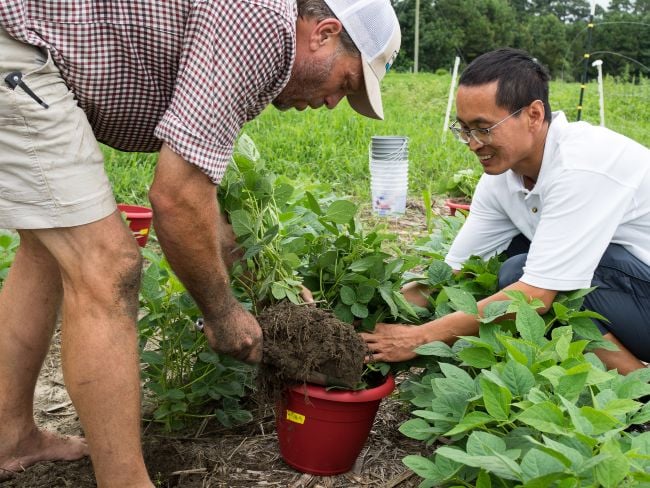
Another key collaboration is with Adrienne Gorny from North Carolina Central University. “The RNAi project would not be possible without Gorny lab’s ongoing testing in greenhouse conditions,” Li said.
Additionally, the Institute for Advanced Learning and Research (IALR) Analytical Chemistry Lab in Danville, Virginia, conducts much of Innatrix’s growth chamber testing for peptide-based biofungicides, helping supplement the company’s greenhouse facilities.
From idea to investment
Innatrix was founded in 2013 by Marshall Edgell, a long-time member of the microbiology faculty at the University of North Carolina at Chapel Hill. Li joined the company as research director and senior scientist in 2018 and was named CEO in 2020.
Innatrix is supported by the United Soybean Board, NSF and USDA SBIR grants, as well as the North Carolina Biotechnology Center. A seed fundraising round led by a prominent Boston-based agtech investor is in progress and should be finalized by the end of 2025.
Li says that the small business loans the company received from NCBiotech in 2021 and 2023 were instrumental in helping the company demonstrate the potential of its technology, advance product development, expand testing, and build collaborations that supported large-scale manufacturing. The company has also benefited from NCBiotech’s Industrial Internship Program grants.
The company’s connection with NCBiotech extends beyond financial support. As a member of NCBiotech’s North Carolina Agtech Council, Li contributes to the group’s work to address key opportunities, challenges and gaps impacting innovation and economic development for the agtech sector across the state.
“Being on the council has helped me connect with leaders across government, academia and industry, and also provided an opportunity for me to help other startups find the resources they need,” said Li. “The council members help each other succeed while strengthening the agtech community as a whole.”
He adds that the RTP area’s mix of agtech startups, industry leaders, universities and research institutions has created a collaborative ecosystem that fuels agricultural innovation and provides access to exceptional talent and resources.