

Ag Allies conference touches on trade, the resilient farm economy and food security
Key Takeaways
- Trade touches every corner of NC ag: With the U.S. signing 10 new agreements since 2025, the focus is turning market access into real sales
- The farm economy is resilient: Cattle operations are strong, even though many row-crop farms are still losing money as input costs outpace prices. After-the-fact payments are no substitute for a farm bill and a long-term strategy that farmers can plan around
- For the speakers, success lies in trade balances, jobs created and food security: Brett Sciotto argued agriculture would be stronger if more of the value chain agreed on some shared goals, while others called for a more collaborative value chain
North Carolina agriculture is BIG business, contributing $117 billion annually to the state’s economy. That represents one-sixth of the state’s overall income and 16 percent of its workers, as outlined in a 2026 industry sector snapshot prepared by North Carolina State University’s College of Agriculture & Life Sciences. The state ranks 9th in the U.S. for value of agricultural products sold.
This robust sector involves not just growing crops and raising livestock, but harvesting, manufacturing, packaging and distributing products amid constantly changing regulations and policies, an evolving workforce, new technology, and shifting U.S. and global economic forces.
Agribusiness leaders, policymakers and industry experts gathered Oct. 30 in Raleigh for the NC Chamber’s annual Ag Allies Conference, presented by BASF Agro, to discuss the state of the industry and how best to ensure it continues to thrive. The event grew out of the North Carolina Ag Leads effort, a strategic planning initiative for agriculture, launched in 2023 by Golden LEAF Foundation and the Chamber Foundation, with support from the North Carolina Farm Bureau and Google.
USTR objectives, successes
NC Chamber General Counsel Ray Starling welcomed attendees and introduced the first session, U.S. Ag Trade Outlook, featuring Ambassador Julie Callahan, chief agricultural negotiator, Office of the U.S. Trade Representative (USTR), and Gregg Doud, president and CEO, National Milk Producers Federation, and former chief agricultural negotiator, USTR.

U.S. Trade Representative office priorities have revolved around “America First,” aimed at reversing the agricultural trade deficit, speakers said. USTR also has utilized broad tariff leverage to secure new Free Trade Agreement-level accords, starting with Southeast Asian markets.
“The central objective is a return to a trade surplus, driven by strict reciprocity and granular enforcement of facility registrations and licensing, Callahan said.
Speakers noted a new framework established to stabilize the U.S.-China agricultural relationship, targeting $30 billion in U.S. exports to China. These would be matched by $30 billion in Chinese exports to the U.S. to prevent retaliatory tariffs.
Ag economic outlook
The morning’s second session turned to other federal issues affecting agribusiness. Bart Fischer, Ph.D., co-director of the Agricultural and Food Policy Center at Texas A&M University, presented the “Ag Economic Outlook.” He reviewed the complex interplay between agricultural economics and federal policy.
Congress last enacted a Farm Bill in 2018 but has not yet brought forward a new bill that could address inflationary pressures on agriculture. In the meantime, he said, “Congress has provided $150 billion in ad hoc assistance to the industry.” This funding mechanism means farmers, livestock and other agricultural producers may not be able to plan based on what monies will be available.
“Farmers generally dislike this reactive model, preferring a robust, predictable safety net over ‘after the fact’ payments,” he added. Still, the industry has benefited from the following Congressional allocations:
- $21 billion in Emergency Relief Assistance, for production losses due to natural disasters;
- $12 billion in Farmer Bridge Assistance, a one-time payment to American farmers with an additional $1 billion for additional commodities, to “bridge” any gap until the appropriations benefits in the “One Big Beautiful Bill Act” are available; and
- $8 billion for the new Harvest Fuel Relief program, targeting on-farm fuel cost increases.
Going forward, Fischer anticipates beef supply will remain tight, driving higher prices and concern regarding consumer inflation, and barriers to global trade may continue. “While the meatpacking industry faces intense scrutiny for market power, its efficiency and quality rewards continue to support record demand,” he said.
Price and convenience still dominate
Turning to North Carolina issues, leaders from food and agriculture industries provided insights during the third session, “Food Manufacturing in NC – A Symmetrical Opportunity for Ag?” Participants were Matt McCollum (CEO, Garner Foods), Jamie Crumley (CEO, Park Leaf Meat Packing), and Mohan Valluri (Alamance Foods). Sarah Grace Lee, NC Ag Leads manager, NC Chamber Foundation, moderated the session.
Moving raw production to value-added manufacturing involves multiple steps affected by various factors. One key factor is the ongoing conflict between consumer demand for “local” products and the economic realities of scaling up to meet greater demand. Social media trends highlighting specific products may drive initial product attention, but panelists cautioned they don’t always translate into longer-term market demand.
“Consumers may voice a preference for local, high-quality and transparent purchasing, but their purchase behavior remains dominated by price and convenience, Crumley said. “Small butcher shops struggle for foot traffic while big-box retailers remain dominant.”
Valluri, with Alamance Foods in Burlington, agreed. “Attention does not equal demand,” he said. Successful product development, he said, requires identifying “the underlying psychological behavior rather than chasing fleeting TikTok trends.”
Established brands rely on different strategies. Garner Foods manufactures Texas Pete, a well-known brand of hot sauce. (“Garner” refers to the company’s founding family, not the North Carolina city; the company’s home is Winston-Salem.)
Hot sauce lovers have been buying Texas Pete since 1929, and it’s a rare barbecue restaurant that doesn’t have the spicy sauce on its tables. Consumers know what they want, and they want the Texas Pete they’ve known for years. “The competitive advantage for us is not innovation for innovation's sake, but the consistency and quality that consumers rely on for everyday use,” McCollum said.
Panelists also discussed the food-processing axiom, “bigger is better.” Scale provides purchasing power for raw materials and packaging and ensures product consistency, McCollum said. However, there may be an innovation trade-off, meaning large-scale operations lose the nimbleness required for rapid prototyping of new products.
Alamance Foods mitigates this trade-off by using an “AI Lab” innovation center to test small-scale ideas before integrating them into the larger supply chain. Crumley observed that while small plants are often the primary innovators, they may find the financial risk of failure too prohibitive to ever reach scale.
We are all working toward a shared vision of strong rural communities that are essential to North Carolina’s success—and agricultural is essential to that success.
—Scott Hamilton, Golden LEAF Foundation
Proactive adaptation is the path forward
State infrastructure needs were next on the agenda. The state is rich in raw materials but needs more secondary processing capacity to realize greater value. For example, North Carolina cattle are shipped to the Midwest for finishing and processing, then the beef to be shipped back to North Carolina grocery stores. Panelists agreed this represents a massive, missed opportunity.
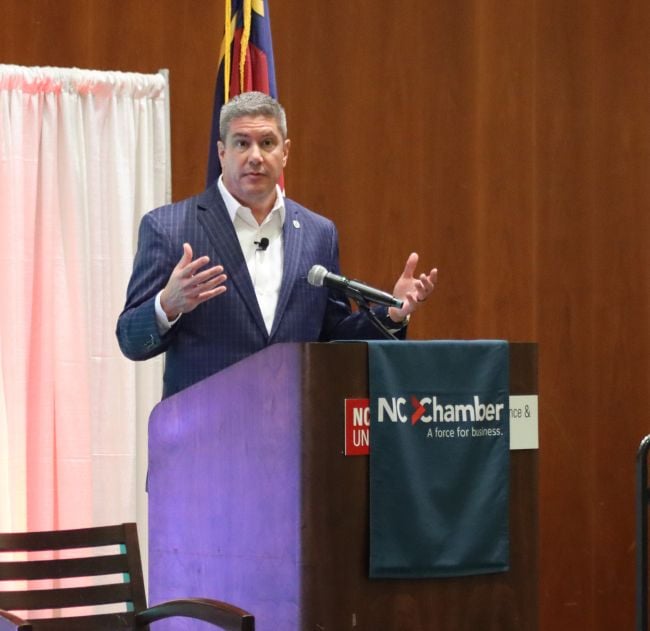
The last morning session was led by Brett Sciotto, CEO of the Center for American Food Power, a non-partisan organization facilitating a “National Ag Strategy” to move the industry toward a resilient bioeconomy.
“The ‘check engine light’ for U.S. agriculture is on,” he said. “High operating expenses and shifting global demand are fracturing the current system.” Troubling signs include the $25 billion agricultural trade deficit and the evolving definition of “food security” as more than access to calories, but the ability to feed Americans nutritious, domestically produced food without relying on adversarial nations, he added.
Other concerns include increasing economic pressure, consolidation and economic stability of the nation’s farms. “In 2025, half of American farmers and ranchers lost money. In states like Ohio, some have seen four consecutive years of losses,” he said. “Projections suggest a 30 to 45 percent reduction in the number of farms over the next decade.”
For the next century, he said, “The path forward is proactive adaptation.” Success will be measured by nutritional quality and value-added attributes, rather than focused on quantity and “outdated market signals on health and nutrition,” he added.
Golden LEAF turning ideas into action
In the afternoon, attendees learned more about NC Ag Leads activities from Scott Hamilton, president and CEO of the Golden LEAF Foundation, and Gary Salamido, NC Chamber’s president and CEO.
Golden LEAF Foundation is a nonprofit organization established in 1999 to receive a portion of North Carolina’s funding from the 1998 Master Settlement Agreement with cigarette manufacturers. It has worked to increase economic opportunities in North Carolina’s rural and tobacco-dependent communities. The LEAF in Golden LEAF stands for Long-term Economic Advancement Foundation.
Hamilton thanked Salamido, the Chamber and the Chamber Foundation and the N.C. Farm Bureau for “turning ideas into action” through Ag Leads. In May 2025, Ag Leads released a collaborative strategic plan for agriculture. Since then, Hamilton said, “We are beginning to see progress.”
Current activities revolve around farmland, workforce and innovation. For farmland, Hamilton said, “We have developed a partnership with American Farmland Trust we are calling Ground Truth NC” to provide a more complete understanding of farmland across North Carolina. “We want to develop reliable information to help guide future actions,” he added.
As for workforce, “North Carolina has tremendous resources,” he said. They include the university and community college systems, non-profit entities and other educational programs such as North Carolina Cooperative Extension, a statewide program that includes 1,000+ university experts and 101 local centers statewide. “We need to strengthen the workforce pipeline and are seeing the value of bringing together stakeholders to develop training and meet needs,” he added.
To help accelerate this effort, he said, Golden LEAF has awarded a $100,000 grant to the NC Chamber Foundation to lead the Agricultural Workforce Intelligence Pilot. The six-month, employer led initiative will identify and address workforce gaps in North Carolina’s agriculture sector.
The third focus area is innovation. “We want to put farmers at the beginning of the innovation process, giving them a greater voice in the problems that need to be solved and what solutions will work,” he said.
Hamilton sees “tremendous potential” to be realized through the initiative. In August, he said, the Golden LEAF Foundation Board of Directors awarded the NC Chamber Foundation a $456,000 grant to support another year of NC Ag Leads activities. “We are all working toward a shared vision of strong rural communities that are essential to North Carolina’s success—and agricultural is essential to that success.”
Thanking Scott Hamilton of Golden LEAF
NC Chamber’s President Gary Salamido next took the stage and began by praising Hamilton, who will step down from Golden LEAF after seven years a president. “Scott has been a tireless advocate for rural, tobacco-dependent and economically depressed communities,” he said. “Through his work with NC Ag Leads, he has built an enduring legacy for many years to come.”
Salamido then presented Hamilton with a special farmland print with a frame made from tobacco leaves.
Demand high for all meats, protein
NC Chamber General Counsel Ray Starling hosted the day’s final session: a conversation with Julie Anna Potts, president and CEO of the Meat Institute, where she leads programs, advocacy and operations in the U.S. meat and poultry industry. Their topic: The American Meat Industry in Transition.

The institute is the oldest and largest U.S. trade association, representing about 95 percent of red meat producers and 50 to 70 percent of poultry producers, she said. The organization’s mission is, “To produce good food the right way with respect for our people, animals, communities and planet.” She emphasized members come in all sizes, from global giants such as Smithfield Farms to small processors.
Her career includes 14 years at the American Farm Bureau and serving as staff to the U.S. Senate Agriculture Committee. When it comes to agriculture, she said, “I have a pretty good farmer perspective.”
In today’s U.S. meat production industry, diversity is key. “Our beef production is up,” and the industry has expanded around newer consumer proteins such as bison and duck. “We have an ample supply of pork and poultry and demand is high for all meats,” she added.
Factors contributing to high demand include Gen Zs, or Zoomers, born from 1997 to 2012. “They are leading the pack when it comes to consuming proteins.” She also cited people taking GLP-1s, popular prescription drugs that mimic the hormone glucagon and help lower blood sugar, reduce appetite and support weight loss.
The drug information website GoodRx notes that for people on GLP-1s, consuming enough protein is, “one of the best ways to protect against muscle loss that can happen as a side effect of weight loss.” Lean beef contains 20 to 26 grams of protein per 100 grams (3.5 ounces) of cooked meat. The protein helps reduce loss of muscle mass during weight loss, GoodRx noted.
Other issues for meat and poultry producers include developing the correct infrastructure, such as increasing the number of production facilities in rural areas and the slow timetable for livestock production. “Cattle can’t come back quickly,” she said. “It takes at least two years.”
Regenerative agriculture is “being talked about in D.C.,” Potts said. The U.S. Department of Agriculture defines the term as, “a holistic approach to farming and ranching that aims to improve the health of the agricultural ecosystem, with a particular focus on regenerating soil health.”
It’s being talked about and acted on in North Carolina through the Center for Environmental Farming Systems, a “partnership of N.C. State University, North Carolina Agricultural & Technical University and the N.C. Department of Agriculture and Consumer Services. Housed at N.C. State, the center, “develops and promotes regenerative practices such as reduced tillage, cover cropping, crop rotation, and rotational livestock grazing,” according to the center’s website.
“This approach seeks to sustain agricultural production while actively enhancing the natural resources on which it depends,” the web content continues. “Longer-term benefits could include increased biodiversity, improved water cycles, carbon sequestration and greater farm resilience.”
Read more about Ag Allies and ag tech:
- N.C. agriculture economy poised to address multiple challenges | North Carolina Biotechnology Center
- Upstream Biotechnology raises seed funding for crop protection tech | North Carolina Biotechnology Center
- Plant Sciences Initiative at NC State a key player in global research program to accelerate agtech start-ups | North Carolina Biotechnology Center