

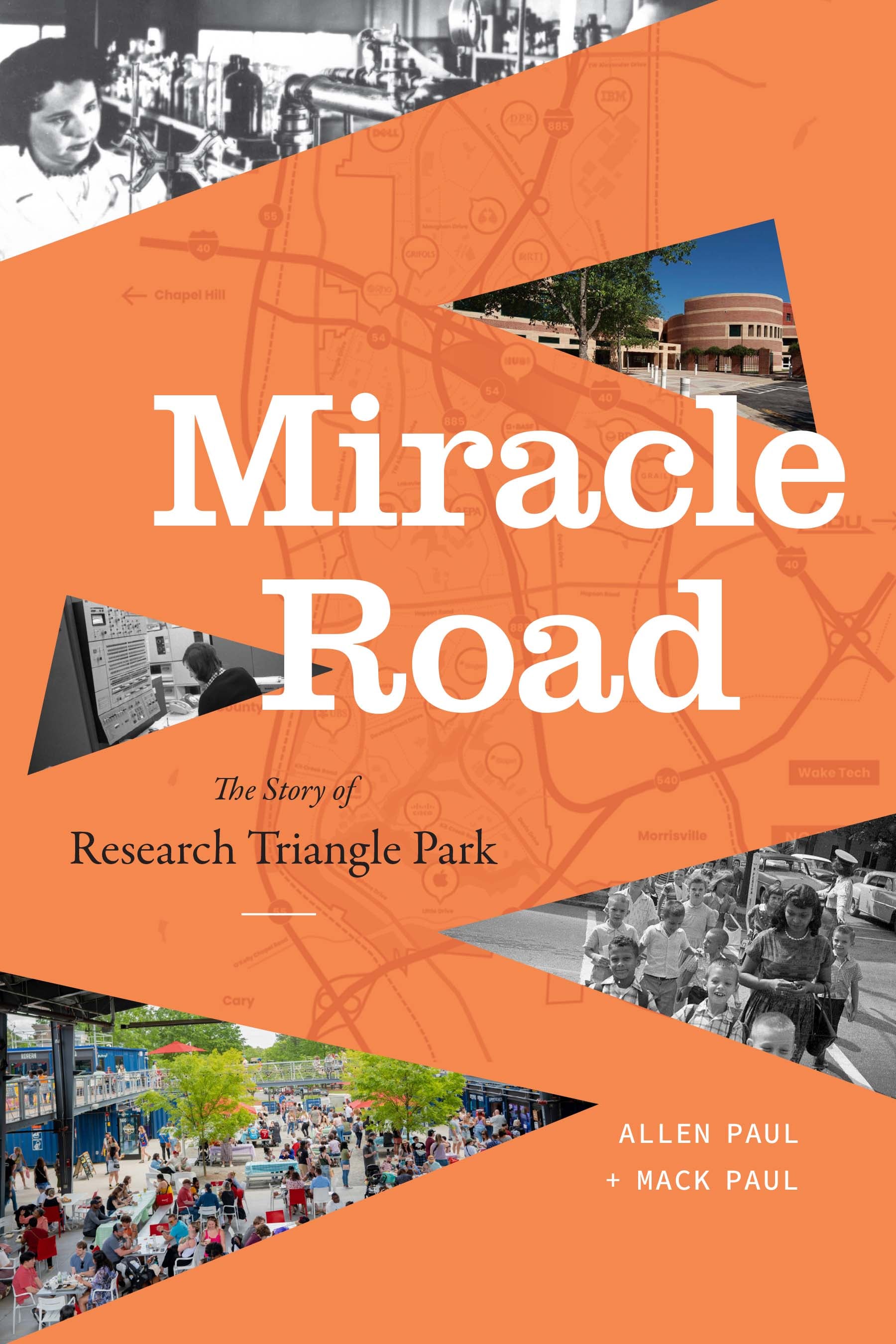
“Miracle Road” brings human focus to RTP’s miraculous existence
Key Takeaways
- 'Miracle Road': New book about the origins of Research Triangle Park to launch on Oct. 6, 2026.
- Visionary state leadership: “Miracle Road” is the quintessential diary of what, how, and especially who made RTP what it is today, with some closing observations and suggestions about what might come.
- Largest in the U.S.: What started as a way to attract companies to the South became a location for tech and science research labs, which then evolved into the largest science park in the country.
As poet Maya Angelou famously said, “You can’t really know where you are going until you know where you have been.”
That wisdom applies today to the planners and dreamers who are bringing a vibrant new identity to the iconic North Carolina landmark known as Research Triangle Park (RTP) 3.0.
Soon a soul-searching RTP retrospective will be launched in book form as “Miracle Road, the Story of Research Triangle Park.”
The book is the result of some 10 years of research and writing and more than 160 interviews by two Raleigh authors: journalist and writer Allen Paul and his son Mack, also a writer and a real estate development attorney. Nearly all the interviews were recorded and transcribed. The Pauls completed the manuscript in November 2025. Allen died on Memorial Day, May 25, 2026.
The October 6, 2026, launch date for the book is a close fit with the recent unveiling of RTP 3.0. That’s the moniker for a major 50-year transformation of RTP’s look and feel, from the original single-use corporate campus R&D layout of RTP 1.0 and the interim experiment with Hub RTP to add mixed-use options such as apartments and dining as RTP 2.0. Now, RTP 3.0 embraces land-use and zoning changes that enable a more urbanized live-work-play vibe for the site.
In the book, we argue that RTP needs to be the living expression of an economic development strategy. It’s a physical place that requires care and attention, but it began as a strategy to attract companies to the South, as we’d done for furniture and textiles. Then it evolved to show tech and research labs where they might locate. And ultimately, it became the largest science park in the country.
— 'Miracle Road' author Mack Paul
’“Miracle Road” is the quintessential diary of what, how, and especially who made RTP what it is today, with some closing observations and suggestions about what might come.
A public book-launch event will be held October 13 at the North Carolina Biotechnology Center in RTP. Details will be announced soon.
Community leaders who organized a book oversight committee helped the Pauls with the project and raised funds from individual and corporate donors to support its completion. The committee was initially chaired by Bob Ingram, a major force in North Carolina’s life sciences growth to global importance, and coordinated by Doug Edgeton, president and CEO of NCBiotech. Since Ingram’s death in March 2023, the committee has been chaired by John Atkins III, chairman of the RTP-based O’Brien Atkins, former NCBiotech board chair and Durham Chamber of Commerce president.
Other committee members were Christy Shaffer, a partner in Hatteras Venture Partners; Luther Hodges Jr., former U.S. Deputy Secretary of Commerce and son of Gov. Luther H. Hodges Sr.; Fred Hutchison, founder of Hutchison PLLC; Robb Teer, president of Teer Associates; and Smedes York, chairman of York Properties and former chairman of the Research Triangle Foundation. Charles Hamner, D.V.M., former president and CEO of NCBiotech, was on the committee until his death on July 4, 2025.
Though other useful books have been written about RTP, “Miracle Road” offers readers a unique exposure to the stories and people behind the park’s evolution. It also helps explain the atmosphere of partnership and respect that overcame some of the most serious difficulties of the Jim Crow South that ultimately forged North Carolina’s international reputation as a leader in collaborative scientific and educational innovation.
Possums and pines
It was a somewhat desperate gamble when visionary state leaders shared an aspiration in 1959 to convert what would ultimately be 7,000 acres of “possums and pines” connecting the region’s three top universities in three distinctly different municipalities.
Stung by North Carolina’s not-so-distant history as the nation’s second-poorest state, the creators of RTP saw promise in partnerships that could lift all boats. They believed that research emanating from Duke and North Carolina State universities and the University of North Carolina at Chapel Hill could become a regional force capable of moving North Carolina onto a global stage of science and technology stardom.
It worked. And 67 years later it’s still a work very much in progress.
“In the book, we argue that RTP needs to be the living expression of an economic development strategy,” said Mack Paul in his most recent interview with NCBiotech. “It’s a physical place that requires care and attention, but originally it was a strategy to attract companies to the South as we’d done for furniture and textiles. Then it evolved to show tech and research labs where they might locate. And ultimately it became the largest science park in the country. That required full buy-in by the Triangle’s universities, the business community, and state and local governments.
“The book talks quite a bit about the struggles and resistance to RTP's original model, starting in the early 2000s, with the rise of the creative class. It quotes economic developers saying it became increasingly tough to attract talent because we didn’t have the innovation hubs competitors had.”
Atkins said he finds the book compelling “because it’s really about the people who made RTP what it is.”
“It does follow a chronological path, but it’s not just a chronological history,” he noted. “It includes corporate entities, but in a way that tells stories about what real people did in those corporate entities. It’s a human-interest story. It was always interesting when our advisory committee would meet with Allen. He was familiar with RTP; he was a great writer with a wonderful style, and he understood the human-interest side of RTP. But he didn’t have the knowledge that the committee members who grew up here and lived through it had. So, we helped him fill in the gaps. We’d tell him, ‘You need to go talk to Dick Daugherty about IBM’ or ‘You need to talk to Gary Shope,’ things like that.
“We never had a committee meeting conclude without some committee member saying, ‘Oh, I remember so-and-so,’ and then they would tell a story,” Atkins said. “We joked among ourselves that this is a book that just doesn’t have an ending to it. I share this because this thing called RTP is a dynamic organism that keeps living and producing stories of people committed to science, innovation, the economic development of North Carolina, the wellbeing of the Triangle, the state, the world.”
‘Something in the water’
NCBiotech’s Edgeton agreed. “This book has a lot of great stories about things that people discovered and did that have helped humanity, which makes it very compelling,” he said.
“I equate it to a lot of the things that North Carolina has done exceptionally well with a lot of community spirit. North Carolina is not only the home of RTP, the oldest continuously operating planned research park. Long before, it was the first provincial congress to formally call for independence from England. It was the first state to develop a public university, right here in Chapel Hill. It’s the first to develop a comprehensive, successful statewide community college system. The first to create a biotechnology center, an organization that fits outside state government with the function of helping to grow a life sciences sector statewide.
“When we do things like that, we learn to create and think differently, and I believe Mack does a great job of talking about it in the book. About how our state approached racial tensions and segregation in a way that ultimately gave us a competitive advantage, and landed IBM in 1965. IBM was, for lack of a better word, the proof of concept that RTP was the real deal. And that was only about six years after RTP had been formed.
“Wake Forest was the first university in the South to integrate. That was in 1962. I think it's something in the water here,” added Edgeton. “North Carolinians think of things differently. We try to be very accommodating and giving and helpful and try to work together. And I think that's been a major part of the competitive advantage we've had when it comes to company recruitments, as well.”
RTI’s, Biogen’s roles in RTP
Tim J. Gabel is president and CEO of RTI International, the cornerstone RTP enterprise that has become a global research power. He added, “We’ve had the privilege of helping shape what has become one of the nation’s leading centers of innovation, as captured in ‘Miracle Road.’
“I’m incredibly proud of the role RTI has played for the past seven decades in building RTP into what it is today, bringing together partners across sectors and regions to deliver science-driven solutions that benefit people in North Carolina and far beyond. RTI’s success as the anchor tenant was foundational to RTP’s success and we look forward to many more decades of collaboration and partnership.”
Nicole Murphy, executive vice president and head of pharmaceutical operations & technology at pharmaceutical giant Biogen, also weighed in on the importance of RTP and the book.
"Biogen's journey in Research Triangle Park reflects the vision and collaboration that has made this region one of the world's leading biotechnology centers,” she said.
“Since establishing operations in RTP in the 1990s, we have benefited from a rich talent ecosystem and a community dedicated to scientific advancement. Together with the talent, skill, and dedication of our employees, the unique partnership among industry, academia, and government that has shaped RTP has enabled companies like Biogen to advance and deliver breakthrough life-changing therapies to patients around the world. We are honored to be included in this book's account of the people, partnerships, and pioneering spirit that continue to define RTP's success."
Besides lead support from AskBio, Biogen and RTI, many other companies, individuals and organizations provided sponsorship support and funding for the project, including Alexandria Real Estate Equities, Parker Poe, Novonesis, Novo Nordisk, Smith Anderson and Wells Fargo.
Published by Duke University Press, the 298-page six-by-nine-inch hardcover book will retail for $34.95. Upon publication, it will simultaneously be available in Kindle/e-book digital format.
Distributor Porchlight Books is providing quantity discounts, starting at 15% off for orders of two or more copies, 38% off for 25 or more, 40% off for 100 or more, 42% off for 250 or more and 43% off for 500 or more.
Read more about RTP
RTP celebrates future mixed-use development of 'RTP 3.0' | North Carolina Biotechnology Center
History of Biotechnology in North Carolina | North Carolina Biotechnology Center