

Innatrix awarded NSF SBIR grant to accelerate eco-friendly biopesticide commercialization
Innatrix Inc., a Durham-based agricultural biotechnology company developing sustainable biological crop protection solutions, was awarded a $499,786 Small Business Innovation Research (SBIR) Phase IIB grant from the U.S. National Science Foundation (NSF).
The supplemental funding will support moving Innatrix’s lead peptide product, InnaLB, toward U.S. Environmental Protection Agency (EPA) registration and market launch.
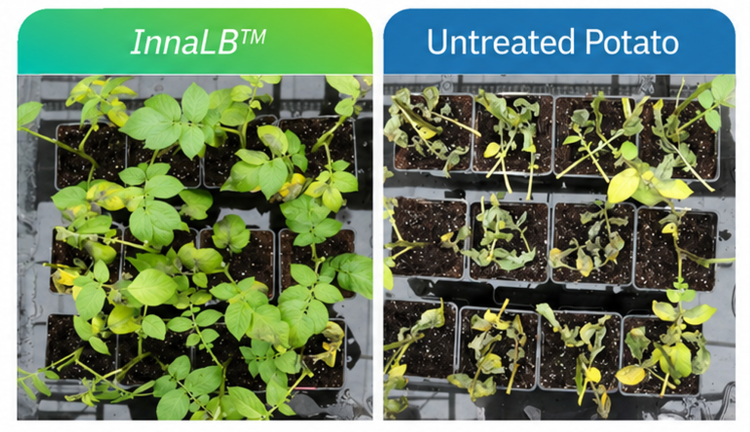
InnaLB targets Phytophthora infestans – also known as late blight. This aggressive pathogen causes around $6.7 billion in global potato production losses each year.
The new award increases the total NSF funding for the project to $1,702,087 and extends the performance period through Sept. 30, 2027.
"Receiving this NSF SBIR Phase IIB award validates our platform's technical accomplishments and commercial trajectory," said Dr. Jiarui Li, founder and CEO of Innatrix Inc. and PI for the new award. "Late blight continues to cause catastrophic crop losses globally. With NSF’s continued support, we are positioned to complete critical safety, formulation, and manufacturing milestones, moving InnaLB toward registration and commercial launch alongside our strategic industry partners."
Advancing toward registration
InnaLB was developed using the company’s proprietary target-based discovery platform, which can deliver durable biological solutions in as little as four years at a fraction of the cost of traditional approaches.
During the Phase II project, Innatrix achieved several key scientific and regulatory milestones for InnaLB. These include demonstrating that the peptide-based biological product could achieve up to 80% control against late blight in potatoes and tomatoes and was also effective against cucurbit downy mildew, grape downy mildew, and potato pink rot.
InnaLB also received a "biochemical-like" classification approval from the EPA, which establishes a streamlined, lower-cost regulatory approval path for the peptide-based biofungicide.
“We have been working with a strategic partner to independently confirm peptide efficacy, while advancing a strong global patent portfolio spanning peptide compositions, delivery and manufacturing methods,” said Li. “Additionally, we mapped out a 2-year production roadmap with the goals of achieving a low cost of goods and long-term product profitability.”
With the Phase IIB funding, Innatrix will focus on using computational redesign to enhance the peptide’s half-life and optimize bioprocessing to improve peptide stability and manufacturability.
The company will also continue to work on formulation development with a goal of creating stable, spray-tank-ready liquid formulations using EPA-approved safe adjuvants. It also plans to complete the animal safety and environmental studies needed to prepare its product for formal registration with the EPA.
Home-grown innovation
Innatrix was founded in 2013 by Marshall Edgell, a long-time member of the microbiology faculty at the University of North Carolina at Chapel Hill. Li joined the company as research director and senior scientist in 2018 and was named CEO in 2020.
In addition to the NSF SBIR grants, Innatrix is supported by the United Soybean Board, USDA grants, and two small business loans from the North Carolina Biotechnology Center. The company is currently raising a $2 million seed round to support continued growth and development of its biological crop protection solutions.
"North Carolina’s vibrant AgTech hub and the exceptional talent pool in the Durham area have been instrumental in our momentum," said Li. "Access to world-class research institutions, specialized ag-biotech support, and strategic regional partners and investors enabled us to de-risk our platform and advance InnaLB™ efficiently from initial discovery to real-world field validation."
Read more about Innatrix: