

First 3D-bioprinted corneal transplant marks early milestone for Triad’s Precise Bio
Precise Bio Inc., a Greensboro-based clinical-stage regenerative medicine company, has announced the world’s first transplant of a cell-based, functional, 3D-bioprinted cornea. The procedure took place Oct. 29 at Rambam Medical Center in Haifa, Israel, as part of the company’s ongoing Phase I clinical trial.
“This achievement marks a turning point for regenerative ophthalmology—a moment of real hope for millions living with corneal blindness,” said Precise Bio co-founder and CEO Aryeh Batt. He has more than 20 years of executive experience leading product management and development of innovative technology products, and bringing them from R&D to sales.
“For the first time, a corneal implant manufactured entirely in the lab from cultured human corneal cells, rather than direct donor tissue, has been successfully implanted in a patient, establishing a pivotal milestone for ophthalmology, regenerative medicine and the future of tissue engineering,” Batt added.
The cornea is a clear, dome-shaped layer at the front of the eye. Special cells within the eye keep the cornea lubricated, pumping in fluid and draining excess as needed, ensuring clear vision. Injury or medical conditions can interfere with the cells and fluid balance, causing corneal swelling and damage. Without treatment, initial blurry vision and eye pain can progress to blindness as the cornea clouds over completely.
Donor-tissue shortage limits corneal transplants
For many patients, the optimum treatment is a corneal transplant from donor tissue. As with other organ transplantations, there are too few eye-tissue donations to address a global problem affecting millions.
Unlike traditional implants that rely on limited human-donor tissue, Precise Bio’s PB-001 is engineered to replicate the optical clarity and biomechanical properties of the native cornea, the company’s announcement said. The implant is manufactured at Precise Bio’s GMP facility in Sheba Medical Center, near Tel Aviv, Israel, using the company’s robotic 3D-biofabrication system.
Within the facility, Precise Bio isolates, cultivates and prints corneal cells into a precisely layered structure that integrates with the patient’s own tissue. The design aims to deliver improved visual outcomes, lower complication rates and provide consistent quality, while also enabling a sustainable solution to the global corneal donor tissue shortage.
Lab-created cornea using human cells restores sight
Precise Bio’s first Phase I patient was legally blind prior to the Oct. 29 transplantation of the laboratory-created PB 001 in one of the patient’s eyes.
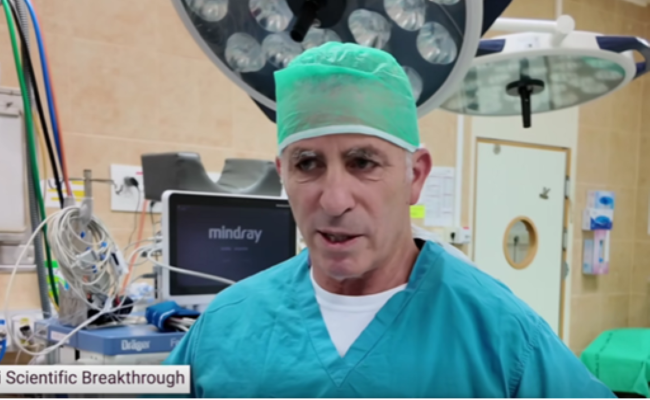
“For the first time in history, we’ve witnessed a cornea created in the lab, from living human cells, bring sight back to a human being. It was an unforgettable moment—a glimpse into a future where no one will have to live in darkness because of a shortage of donor tissue. This is a game changer,” said Michael Mimouni, M.D., cornea unit director in the medical center, who performed the procedure.
Precise Bio’s ongoing Phase 1, single-arm trial at Rambam Medical Center is designed to evaluate the safety and tolerability of PB-001 in 10–15 patients with corneal edema caused by endothelial dysfunction. The study will also explore early efficacy outcomes at six months. Precise Bio expects to announce topline results from the study in the second half of 2026.
“It is exciting to see how scientific leadership in regenerative medicine right here in North Carolina is having a global impact,” said Nancy Johnston, executive director of the Piedmont Triad region for the North Carolina Biotechnology Center.
‘Defining moment’ for regenerative medicine
“This is a defining moment for the future of regenerative medicine,” said Anthony Atala, M.D., co-founder of Precise Bio and G. Link Professor and Director of the Wake Forest Institute for Regenerative Medicine.
 “PB-001 has the potential to offer a new, standardized solution to one of ophthalmology’s most urgent needs: reliable, safe and effective corneal replacement. The ability to produce patient-ready tissue on demand could lead the way toward reshaping transplant medicine as we know it,” Atala added.
The company was established by Batt, Atala and Shay Soker, Ph.D., professor of regenerative medicine and chief science program officer at the Wake Forest Institute for Regenerative Medicine. Combining their experience in regenerative medicine with innovative printing technology has resulted in a GMP production-worthy platform.
NC played an ‘important role’ in early journey
“North Carolina played an important role in Precise Bio’s early journey. The region’s strong biotech and regenerative-medicine ecosystem gave us a supportive foundation as we began translating our technology from concept to real-world application,” Batt said. “We were able to benefit from the innovation culture surrounding Wake Forest and the broader Winston-Salem community, which offered access to talent, expertise and a collaborative environment that helped accelerate our early progress.”
Batt also noted North Carolina has been home to some of the company’s most meaningful partnerships as well. He especially credits Miracles In Sight in Clemmons, near Winston-Salem, one of the largest nonprofit eye banks in the world.
“They recognized very early the potential of our platform to transform the eye-banking system by providing a consistent and scalable source of ocular tissues,” Batt said. “Their support has been invaluable as we move our mission forward.”
Precise Bio is located at Muirwood Office Center in Greensboro. For more information, visit www.precise-bio.com.
# # #
Cutline (IF video screenshot works)
Precise Bio’s CEO in the operating room at Ramdan Medical Center, Haifa, Israel