

Eastern NC biomanufacturing region reports strong growth, expands training programs
Record-breaking investment and innovative workforce development initiatives position eastern North Carolina as a thriving biopharma manufacturing hub
Eastern North Carolina's biomanufacturing sector is experiencing unprecedented growth, with the region capturing the lion's share of statewide life sciences investment in 2024 while expanding innovative training programs to meet surging workforce demands.
Mark Phillips, vice president of statewide operations, and regional director for the North Carolina Biotechnology Center's Eastern region, reports that the region secured $7.1 billion of the state's $10.8 billion in new life sciences investments announced in 2024 and 2025, along with 2,600 of the 4,500 new jobs created statewide.
"We've been very fortunate in our region to see this continued growth," Phillips said, pointing to major expansions and new facilities from industry giants including Novo Nordisk in Clayton, Johnson & Johnson and Reckitt, located in Wilson, and Nipro Medical in Greenville.
Grassroots training program successful at growing workforce
The NCGrads2Work program, which Phillips describes as "one of the most grassroots programs we have," continues to demonstrate impressive results. This program targets high school seniors who apply to participate in the two-day training program, hosted by the Pharmaceutical Services Network at Pitt Community College, with guaranteed interviews from industry partners, Thermo Fisher Scientific and Catalent Pharmaceuticals, both located in Greenville.
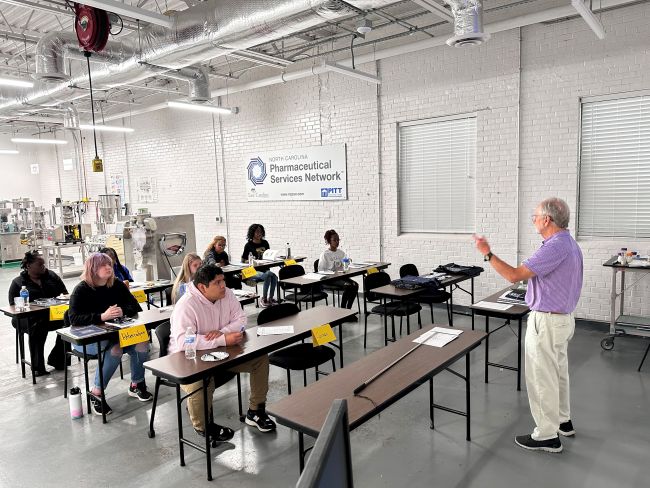
Of 33 high school graduate participants in the 2025 training period, 24 secured employment in the biopharma manufacturing sector—a 73% placement rate. Many of the remaining candidates pursued continued education or found employment elsewhere.
VR training demystifies manufacturing
The region's Pharmaceutical Services Network at Pitt Community College recently completed a major upgrade of its aseptic training facility, incorporating isolator environment technology that reflects current industry trends. The facility also features three virtual reality (VR) training platforms using Meta Quest headsets to introduce high school students to pharmaceutical manufacturing careers.
"Nobody really understands what pharmaceutical manufacturing means if you've never worked in the sector," Phillips noted. "All the average person wants to do is take medicine and feel better—we don't think about how medicines are manufactured."
The VR platforms at the training facility allow students to experience critical concepts, like laminar airflow, gowning procedures, and cleanroom protocols, in an immersive environment. Phillips uses what he calls "the old Charles Schultz Pig Pen effect" to explain contamination control: just as the cartoon character trailed dust wherever he walked, humans naturally shed particles that could compromise sterile pharmaceutical products.
"Everything is completely sterilized in an aseptic manufacturing environment except us," he explained. "So, we must gown ourselves to contain it."
Five decades of strategic development
The Eastern region's current success stems from decades of strategic investment. The Greenville facility of Thermo Fisher Scientific, one of the world's largest contract development and manufacturing organizations, traces its roots to 55 years ago when Burroughs Wellcome opened its first North Carolina facility.
Phillips points to a deliberate ecosystem-building approach that includes East Carolina University's medical school, the state's first dental school in the Eastern region, and a College of Engineering now approaching its 20th anniversary. ECU’s engineering program has a bioprocess engineering concentration that prepares students for positions in biopharma manufacturing at local companies.
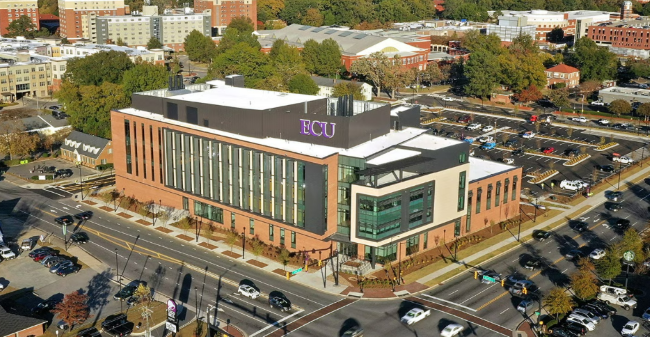
ECU also has the Eastern Region Pharma Center, housed in ECU’s new Life Sciences and Biotechnology building, supported through funding from the Golden Leaf Foundation and the university. Working in partnership with 15 pharmaceutical companies and five regional community colleges, the center is a leader in workforce development for this growing industry.
"That ecosystem has been built deliberately over time," Phillips said. " Strategically, when you put things in place and 50 to 60 years, eventually you have what you need for a great workforce and attracting biopharma manufacturing companies here."
The growth is particularly significant given the region's rural character. East of Interstate 95, approximately 1.4 million people live across 29 counties, many in rural areas facing healthcare disparities.
Wilson's recent wins include a $53 million training facility being built to support Johnson & Johnson's biologics manufacturing operation, a testament to the region's commitment to workforce development infrastructure.
Life Science Summit returns to the East
The region will host the statewide NCBiotech Life Science Summit on Sept. 17, 2026, following a successful Charlotte event this past September. Planning is already underway for the gathering, which will be held at East Carolina University facilities. The event will feature a keynote speaker and dynamic, informative panels on economic and workforce development.
"The event will build on strong collaborations with local industry such as Thermo Fisher and Catalent, as well as educational, training and community partners," Phillips said of the planning process.
As eastern North Carolina continues to attract billion-dollar investments and create thousands of highly skilled jobs, the focus on innovative training and strategic partnership-building positions the region for sustained momentum well into the future.
For more coverage of what's happening in the Eastern Region, see these related articles:
Novo Nordisk plans $4.1B Johnston Co. expansion | North Carolina Biotechnology Center
NCGrads2Work: Helping students leap from high school to pharma | North Carolina Biotechnology Center