

Asheville healthcare startup working to reduce risks of falls in the home
As doctors and patients shift more care delivery to the home, it’s becoming more apparent that homes aren’t always the safest place to be.

A North Carolina startup is working to change that. DwellSafe, whose team works out of Asheville and New York City, has developed a technology platform that combines patient data with a virtual scan of the patient’s home.
By using the system, patients and their clinical teams can identify at-home risks – and then intervene to reduce the likelihood of a fall or other accident.
“Our whole thesis is to create a clinically reviewed window into patients’ homes for healthcare providers,” said James Taylor, M.D., an oncologist who founded DwellSafe while treating a sizable number of patients who suffered setbacks from falls at home. Not only did his patients experience the trauma and injuries from falls, they also saw their cancer care interrupted.
“We’re trying to make home an extension of clinical planning,” he said in a recent interview. “When we initially launched, it was more about fall prevention, but our platform really does a whole lot more than that.”
Expansion on tap
DwellSafe, founded on initial investments from Taylor and his co-founder, Jonathan Hills, is seeking a seed round of funding from venture capital firms and physician practice groups. The additional funds would enable the company to expand its footprint and secure more agreements with healthcare providers.
DwellSafe got a boost in 2024 by earning third place in the NCBiotech Venture Challenge program, presented by the North Carolina Biotechnology Center. The company won regional honors representing the Western region.
"DwellSafe is a wonderful example of a technology-based, clinician-driven startup that received support in the Western N.C. community," said Jonathan Snover, executive director of NCBiotech's Western Office. "Our challenge as a region is to identify or attract more of these types of startups and help them thrive here.”
Revenues come from healthcare systems and practices that have adopted, or are moving to, value-based care, which rewards providers for meeting quality and patient outcome measures. For example, DwellSafe has an agreement with One Health, a large primary care group affiliated with Charlotte-based Advocate Health, to provide services to clinicians and patients.
Taylor explained that most care is reactive: A patient experiences a fall in their home, then has to seek treatment, often for expensive procedures and hospitalizations. DwellSafe helps doctors and hospitals anticipate risks and help patients prevent falls from ever happening. Clinical data can help show where certain patients might be at greater risk because of their age, health condition, prescriptions, use of durable medical equipment in the home, and history of falls.
“We’re designing revenue streams around these eligible patients to move the process up in high-risk populations before there’s an accident,” he said.
Home evaluations
The company’s home evaluation platform is also available to consumers to use. As part of its service, DwellSafe supports aging in place through a collaboration with home improvement retailer Lowe’s to offer virtual home assessments. Consumers can receive personalized guidance on home safety from licensed clinicians.
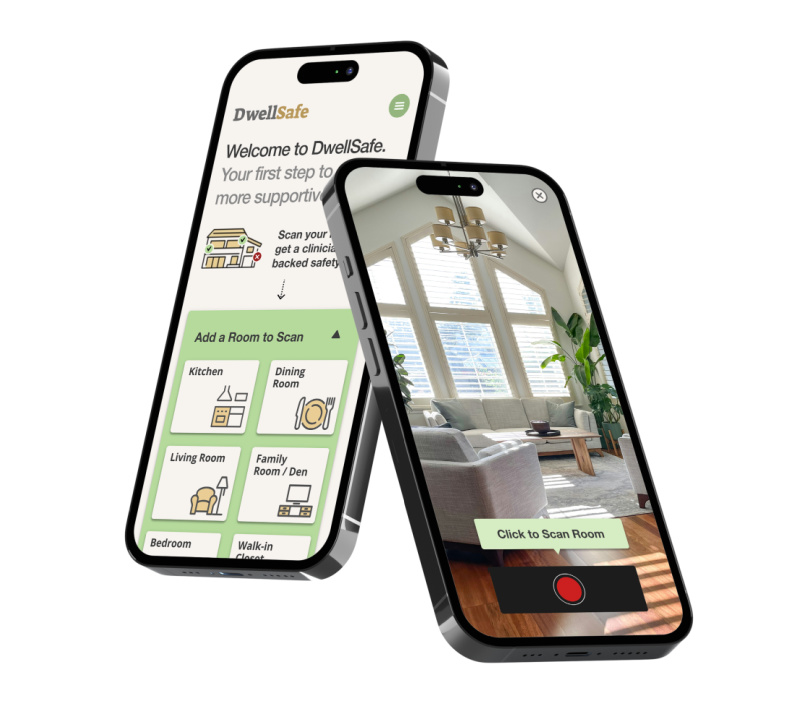
Instructions on the DwellSafe website show how to take images inside the home and then upload them to a clinical team for evaluation and recommendations – adding a grab bar in the shower or bathtub, for example, or securing rugs that could be a trip hazard.
DwellSafe sits in the middle of a growing movement toward delivering care in the home. While at-home care can be easier for patients and is less costly than lengthy recoveries in the hospital, there’s a big difference between care in a clinical setting surrounded by clinicians and care at home with no medical professionals on hand. Taylor wants to build a platform that helps bridge that gap.
“As health care continues to decentralize, whether that's giving therapeutics at home, decentralization of clinical trials, or moving surgeries to outpatient settings with home recovery, the home environment is only going to become a more important driver of clinical care,” Taylor said. “We want people to know that a solution has to exist to connect that home back to clinical teams. We believe that's our solution, and we do think it'll change health care. And we want to start that growth here in North Carolina.”