

AGRITX 'egg spray' technology brings new life to poultry health
If you ask Gina Sloan, Ph.D., the age-old question about which comes first, the chicken or the egg, she’ll have a quick answer: both.
That’s because she’s a poultry pioneer, who is co-founder and CEO of a Statesville company with a unique system for spraying fertilized eggs with nutrients that give a health boost to the developing chicks inside.
The company, AGRITX (pronounced AG-rih-tex), was founded by Sloan and two partners in January 2021 in a small city about an hour’s drive north of Charlotte, where she and her husband also run a cattle farm. 
Sloan is a microbiologist with a bachelor’s degree from Western Carolina University who earned a Ph.D. in 2007 from Wake Forest University. Her AGRITX co-founders are Kevin Parrish, chief operating officer, and Frank Noca, chief brand officer.
The trio met while working at Microban International, a bioscience company headquartered in the town of Huntersville, some 14 miles north of Charlotte. Microban develops and manufactures antimicrobial, odor control, and surface modification technologies used in consumer and industrial products.
“When we started this company, I wanted to control bacteria in a way that could use food as medicine by leveraging good bacteria,” explained Sloan. “Kevin was already in poultry at the time, working on improving hatch or livability using antimicrobial interventions. And Frank joined us to handle the marketing side.”
In April 2026, Austin Glann joined the team. He’s a North Carolina State University poultry science graduate. As the technical sales manager, he brings a decade of major corporate hatchery experience to AGRITX.
Patented solution enhances fertilized egg microbiome
Their lead product is AGRITX-F65, a proprietary blend of pre/probiotics, vitamins, amino acids, and minerals that are U.S. Food and Drug Administration (FDA) or Association of American Feed Control Officials (AAFCO) listed for poultry feed. The formula is designed so that each component enhances the microbiome in fertilized avian eggshells and helps maximize nutrition for the life of the embryo inside.
Sloan’s husband, Josh, is a licensed electrician with an MBA and a background in biology. He works for the company while also managing their 100-acre family farm in Statesville. He developed a proprietary automated spray system for high-throughput application of the water-based AGRITX-F65 liquid formulation. It’s capable of treating some 5,000 eggs every seven seconds as they roll down truck ramps on “farm trolleys” on their way from breeder farms to “setter carts” in hatcheries.
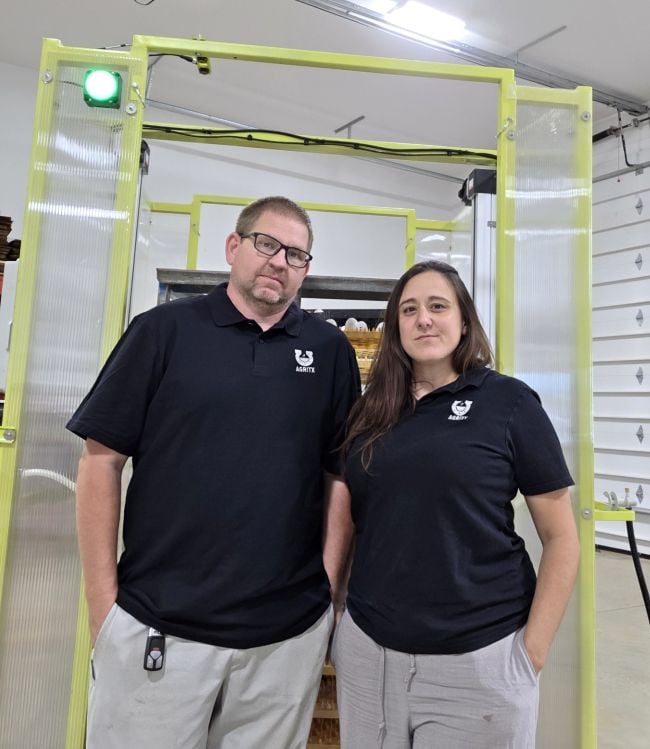
The spray system is calibrated so it doesn’t damage the beneficial bacteria in the company’s formulation, while also depositing them on eggshells. The bacteria then pass through pores in the eggshells and through the egg membrane, where they can find safe haven in the fragile gut of the developing chick inside.
Significantly, it’s not an antibiotic. Instead, it’s a pre/probiotic formulation that’s opening new doors in the world of food as medicine.
First to market with a unique offering
“So far we’re the only ones doing this,” said Sloan, describing the AGRITX process. “Researchers are looking at the eggshell biota, but we’re the only ones pushing a product forward from bench to farm. Some people have tried antimicrobial sprays on eggshells, but with that, you’re cleaning the egg and hatching an empty chick that can readily pick up pathogens in the environment.” Chicks emerging from the AGRITX "spa treatment" eggs, however, are uniquely prepared to confront the constantly morphing array of “bugs" that can create poultry problems.
After hatching, one- to seven-day-old chicks are moved to grow-out farms and then to processing facilities. The process from egg to finished broiler usually takes six to nine weeks. Not surprisingly, some of the chicks die before reaching adulthood. What’s important, Sloan explained in an interview with the North Carolina Biotechnology Center (NCBiotech), is that a one-time egg treatment with AGRITX-F65 is showing a minimum 1% increase in hatch rates. This is at a time of increasing losses for poultry producers seeking help dealing with multiple pathogens of concern, such as avian pathogenic E. coli, Enterococcus and Clostridia. That translates into a potential 10 million additional healthy broilers reaching the marketplace each year in North Carolina alone.
In one proof-of-concept test, AGRITX partnered with a major producer in a one-million-egg trial, spraying 500,000 eggs with AGRITX-F65, with the other 500,000 living on the same farm without the treatment. From the outset, they saw an average 1% improvement in “hatch” from the AGRITX eggs. The benefits extended to improved livability over a 50-day grow-out period, in better weight gain and healthier overall growth in the chickens emerging from the AGRITX-treated eggs.
Chickens from home to boost
North Carolina is among the national leaders in poultry production. According to the United States Department of Agriculture’s National Agricultural Statistics Service (NASS), the big five poultry-producing states are Georgia, Alabama, Arkansas, North Carolina and Mississippi. The rankings vary, depending on what data are included. For example, some rankings only include total pounds of broiler production – the chicken meat we buy at the grocery or restaurant, in which North Carolina ranks #4. That’s also currently AGRITX’s prime focus.
A NASS summary released April 30, 2026, shows that in 2025, North Carolina produced 964.8 million broilers. North Carolina, Georgia and Arkansas accounted for 39% of the nation’s $45.4 billion worth of broiler production.
When NASS counts the total number of birds sold, including turkeys, that raises North Carolina’s rank because it’s the nation’s leader in turkey production – another market Sloan intends to pursue for AGRITX later in 2026.
NCBiotech loan provided early funding
NCBiotech awarded AGRITX a $200,000 Small Business Research Loan in January 2025 to help it develop and manufacture its unique egg coating product. That was followed in August with an initial fundraise from investors.
“We don’t need another raise now,” said Sloan, “but we want to stay in front of investors, and keep getting our story out to our customers.”
Besides expanding into poultry markets such as turkeys, ducks, geese and quail, Sloan plans to open international markets within the next year or so.
“We are in trials with, or actively selling to, 10 of the top 15 poultry producers in the United States,” she said. “The story is resonating with them. It’s not so onerous that they’re not willing to try it. They’re experiencing some of their worst hatch rates ever, and since we improve hatch, we could be in the right place at the right time.”
Sloan noted that poultry flocks are not only subject to the standard array of bacterial challenges, usually related to the gut, but they’re increasingly infected with avian metapneumovirus, a respiratory infection. And another poultry problem not yet identified is a drop in male fertility.
She believes the improved microbiomes the AGRITX technologies make available will help produce sturdier hatchlings from uniquely protective eggs like the world has never seen.
Doug Eisner, J.D., MBA, director of investments on NCBiotech’s Emerging Company Development loan team, agrees.
"AGRITX has created an innovative technology that will significantly improve hatchery productivity," Eisner said. "Built by a talented North Carolina team committed to advancing the poultry industry, AGRITX has the potential to create meaningful impact both here at home and around the world."
“AGRITX brings a refreshing new product and process to agtech,” said Eisner, a veteran agtech entrepreneur and consultant. “Importantly, it is evolving from highly specialized, and clever North Carolinians committed to improving our state’s poultry industry in meaningful ways that will ultimately benefit the world.”