

N.C. life sciences leaders focused on enhancing the state’s strengths
North Carolina’s reputation as a leading state for life sciences is well-known, both in the United States and globally.
But there’s no guarantee that will always be the case. Pharmaceutical and biotechnology leaders, working in conjunction with others who are a part of the state’s life sciences ecosystem, can’t sit still while the rest of the world catches up, speakers at a recent conference in Raleigh emphasized.
“We can’t be complacent about what’s been created here,” said Paul Lewus, vice president and head of site operations in Holly Springs for Amgen, speaking at the Life Sciences Outlook event hosted by the Greater Raleigh Chamber of Commerce and Wake County Economic Development. “It’s fantastic for now. But there are certainly a lot of things that we need to do to make sure we’re focused on the future.”
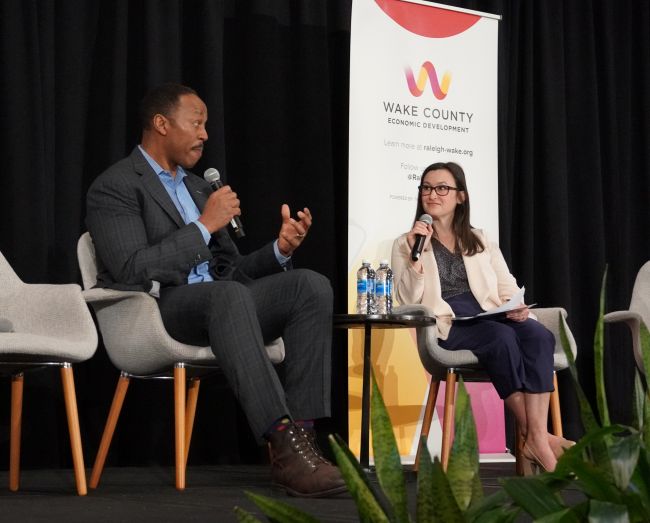
The half-day event featured plenty of discussion about what North Carolina, and the Triangle specifically, has to offer for pharmaceutical, biotechnology and other life sciences companies looking to establish or expand operations, as well as life sciences investors looking for the next great idea.
Those attributes include a highly skilled workforce, universities and community colleges preparing students for life sciences careers, and a steady stream of innovations from researchers and entrepreneurs.
All told, life sciences is worth $82 billion in economic activity annually statewide, employing nearly 80,000 North Carolinians, according to North Carolina Biotechnology Center data. To maintain its leadership position, North Carolina must stay on top of emerging trends that shape how industry leaders view the various regions that are working to attract life sciences investment.
Think global
Travis McCready keeps tabs on life sciences economic development across the globe. As head of industries leasing advisory at commercial real estate giant JLL, he’s observed how site selection has progressed from who you know to what the analytics are telling you.
He views North Carolina as one of the world’s top areas for biopharma. But other locations are working hard to catch up, he said during the opening discussion with Laura Rowley, Ph.D., vice president of life sciences economic development at NCBiotech.
“We have an AI-enabled algorithm that we use with our clients to sort through dozens of variables to come up with sites and locations,” he said. “It is a science. And when you look at that science, other states, in addition to North Carolina, are starting to show up very favorably. My counsel to you here in North Carolina is, don’t get comfortable.”
McCready’s advice? “Stop thinking about North Carolina as a market that needs to be competitive within the context of the United States. Start thinking about North Carolina in the context of whether or not it’s competitive on a global basis. Are you competitive with Shanghai? The game isn’t to beat Boston. The game isn’t to beat California.”
Maintaining NC’s edge
As for ways to keep North Carolina at the forefront of life sciences, other speakers highlighted several necessary steps:
- Step up investments in infrastructure – especially energy, water and wastewater management to support biopharma manufacturing.
- Create more opportunities for biopharma and health delivery to intersect.
- Continuously invest in workforce development.
- Build up entrepreneurs at all phases, from ideas in the lab to regulatory approval and commercialization, and ensure that the venture capital community across the nation knows about the state’s life sciences startups.
And Lee Roberts, chancellor at the University of North Carolina at Chapel Hill, noted that the state’s universities could do more to build strong relationships with life sciences companies and with investors who are looking for opportunities.
Venture capitalists “can’t run around our campus trying to identify the researchers who are doing things that are the most translatable, most investible, and then hope that they’re going to be able to identify…the most promising areas for investment,” he said. “We need to do more of that ourselves.”