
How to Optimize Your Resume
At life sciences companies, such as Pfizer, recruiters may review hundreds of resumes every week. That means your resume has only seconds to make a great first impression and advance in the hiring process. In this article, you will find clear, actionable things you can do to make your resume stand out from the competition.
At a recent NCBiotech Career Development Network event, Aileen Wilson, candidate experience manager at Pfizer, shared her firsthand perspective on what recruiters look for when reviewing resumes. Here’s what she wants every job seeker to know.
The Career Development Network supports students, postdoctoral scholars, job seekers, and life science professionals in advancing their careers. Monthly hybrid meetings, held at NCBiotech’s headquarters in Research Triangle Park, offer an hour of insightful programming covering career search strategies, interviewing and personal branding, as well as networking opportunities.
Prioritize clear and concise formatting
Before a recruiter reads a single word of your resume, they’ve already formed an impression based on how it looks. Clean, consistent formatting signals professionalism is required and makes the recruiter’s job easier.
A well-formatted resume should include:
- Clearly defined sections (work experience, education, and skills)
- Consistent formatting of company names, job titles, and dates
- A single-column layout to avoid confusing applicant tracking systems (ATS)
- A readable font — Nothing distracting, such as Comic Sans
- No photos, bright colors, or decorative elements that distract from the core content
Understand how applicant tracking systems work
Companies use an applicant tracking system (ATS), a software that collects and manages high volumes of job applications. ATS streamlines hiring by filtering resumes for keywords, skills, and qualifications, helping recruiters identify top candidates efficiently. The software is not a substitute for human review.
After you submit an application, your resume is typically processed by the ATS before a human ever sees it.
To ensure that your resume advances past the ATS system:
- Make sure all critical information is in your resume, not just in online application fields
- Avoid fancy formatting, such as text boxes or tables, which can trip up ATS
Lead with what matters most
Recruiters look at your resume with a checklist in mind. Here’s an approximate order of priority:
- Must-have qualifications — Minimum years of experience and required education as stated in the job description
- Relevant work experience — Does your background align with what the role needs? If it’s not an exact match, is it transferable?
- Education — Is your degree in a relevant field that supports the role?
- Technical skills — Specific tools or systems the role requires
- Soft skills — Provide evidence of communication, leadership, and problem-solving
- Achievements and impact — Highlight quantifiable results that show what you accomplished
Structure your resume so the most valuable information is easy to find.
Use the STAR format to describe prior work experience
Instead of listing job duties, write bullet points that summarize your impact using the STAR format: Situation, Task, Action, and Result. This format guides candidates in communicating clear, compelling stories that emphasize personal contributions and quantifiable achievements. The graphic below demonstrates a career achievement with and without the STAR format.
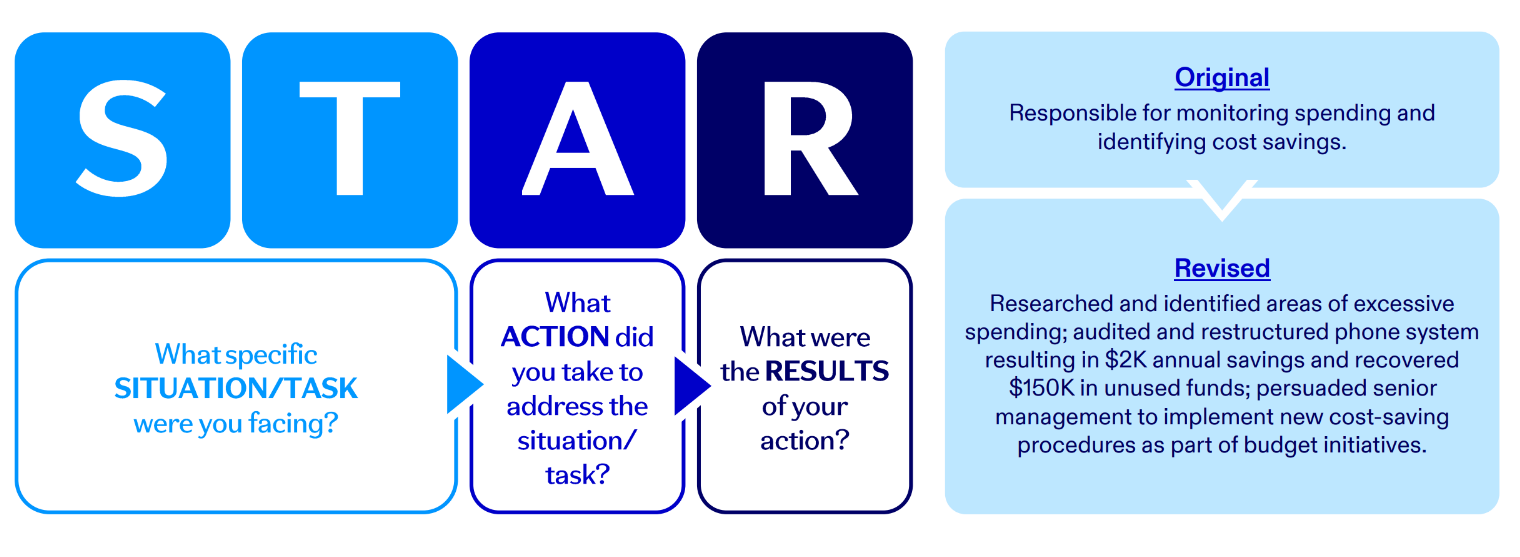
When writing your bullet points, ask yourself:
- What was the situation or challenge I was addressing?
- What action did I take?
- What were the measurable results?
Recommended resume length by career stage
Keep your resume concise while still telling your complete story. Avoid overwhelming the recruiters with too much detail. But if you have decades of relevant experience, own it. The length of your resume will depend on the number of jobs and the length of your career.
Here’s a practical guide to follow:
- Early career: Aim for one page
- Mid-career: Two pages are widely accepted
- Seasoned professionals with 20+ years of experience: Three pages may be appropriate
Highlight transferable skills when changing industries
If you’re switching industries, your job title might not resemble the role for which you’re applying. But that doesn’t mean your experience isn’t relevant. Focus on skills and outcomes, not just job duties.
Common transferable skills to emphasize:
- Project management
- Process improvement
- Communication and training
- Customer service and problem-solving
Use AI as a tool, not a substitute
While AI writing tools can help enhance a resume, the technology is not a substitute for your own voice. Recruiters want to get to know you, and a resume written entirely by AI won’t sound like a human. It’ll sound like everyone else who used the same prompt.
Smart ways to use AI:
- To improve specific sentences with stronger action verbs for greater impact
- To brainstorm how to frame transferable skills
What to avoid:
- Letting AI build your resume from scratch
- Using AI-generated language that erases your authentic voice
Uniqueness is your greatest asset. Let AI enhance your effort, not replace it.
Avoid these common resume mistakes
Wilson flagged several resume errors that she sees often:
- Typos and inconsistencies — Always proofread your resume and have a trusted friend or family member also review it
- Copying verbatim text from the job description into your resume or cover letter
- Including references on your resume — It’s not expected and takes up valuable space
For more information or to watch the full recording, visit the NCBiotech YouTube channel.