

Regenerative Medicine Engine expanding workforce development efforts across N.C.
Key Takeaways
- Going statewide: The Regenerative Medicine Engine is branching out statewide from its Piedmont Triad base
- Focus on workforce: Statewide expansion, begun in 2025, focuses on workforce training and development, resources for entrepreneurs and researchers
- New CEO named: Lester Martinez, M.D., will become Chief Executive Officer of the Engine, effective Nov. 1, 2026. He succeeds Tim Bertram, who has led the Engine since August 2024.
More than a year into its statewide expansion, the Regenerative Medicine Engine in North Carolina is doubling down on preparing the state’s workforce for careers in one of the top emerging fields in science and medicine.
The nonprofit economic development organization helped bring seven new regenerative medicine companies to North Carolina in 2025 and facilitated skills training for nearly 1,500 people. It recently brought on a consultant to boost workforce development across the state.
And the engine, together with the Wake Forest Institute for Regenerative Medicine in Winston-Salem, is making a host of resources available to entrepreneurs and researchers across North Carolina.
“A lot of what’s being done now is to make sure the entire state is open to the regenerative medicine field,” Anthony Atala, M.D., WFIRM’s director and the Regenerative Medicine Engine’s chief innovation officer, said in a recent interview.
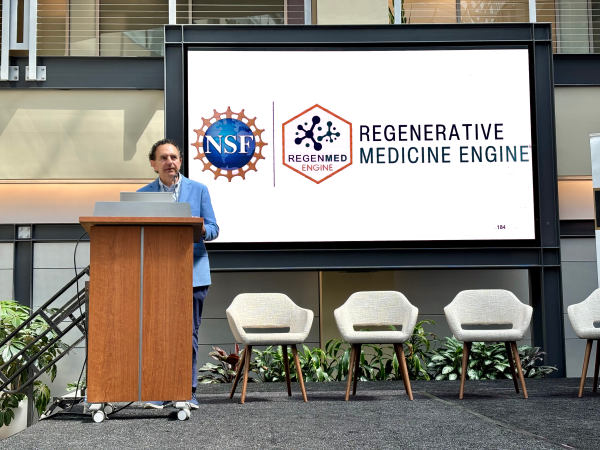
What is regenerative medicine?
Regenerative medicine involves developing therapies that help the body repair or regenerate its cells, tissue and organs. In recent years, the field has grown from an experimental area of medicine into a discipline with demonstrated success in delivering effective treatment to patients. Hurdles remain, however, in getting promising therapies through regulatory approvals and into commercialization.
The engine’s work is focused on helping overcome these and related challenges while promoting the field across North Carolina. Funded through an initial $15 million from the National Science Foundation, with a potential for up to $160 million over 10 years, the engine has spearheaded $270 million in economic development activity and supported 721 new jobs since its inception, according to its 2025 Economic Impact Report.
A lot of people don’t know that regenerative medicine is an area of biotech that’s growing exponentially. There are some very specific workforce skills that people in this area need to have.”
— Carla Johnson, Ph.D., Regenerative Medicine Engine
’In June 2025, the engine announced its statewide expansion and name change from the Piedmont Triad Regenerative Medicine Engine.
Equipping regenerative medicine companies and researchers to hire and train talent is one of the principal missions of the engine. Earlier this year the organization brought on Carla Johnson, Ph.D., to shepherd those efforts as a consultant and workforce development lead.
“A lot of people don’t know that regenerative medicine is an area of biotech that’s growing exponentially,” she said. “There are some very specific workforce skills that people in this area need to have.” These include, for example, knowledge of safety requirements and the ability to work in cleanrooms, she added.
The engine, which currently has arrangements with 13 of the state’s community colleges to help prepare students for working in the field, is working to expand to additional colleges.
Resources for companies, researchers
Combined, the engine and WFIRM collaborate to offer resources to entrepreneurs and researchers in five key areas:
- Workforce development to help ensure a skilled talent pool for regenerative medicine companies to hire from
- An accelerator program for companies seeking help with market validation for their products and innovations
- Regulatory navigation aimed at helping entrepreneurs understand and navigate regulatory approvals
- A product trial catalyst that provides a single contract covering multiple Institutional Review Board (IRB) processes
- And a test bed in downtown Winston-Salem, giving companies access to sophisticated equipment for building and evaluating prototypes at no charge
Atala said these resources are now available statewide.
“Part of our role is to help researchers and entrepreneurs who are trying to bring a product from bench to bedside. We want to make sure companies know that North Carolina is open for business for regenerative medicine.”
Nancy Johnston, executive director of the Piedmont Triad office for the North Carolina Biotechnology Center, said the Regenerative Medicine Engine has made meaningful progress since its 2024 NSF funding, building upon world-renowned scientific leadership.
“What we’re seeing with their expansion statewide is the fulfilment of a vision to advance economic growth,” she said. “As regenerative medicine has grown, so has Winston-Salem and the Innovation Quarter, strengthening the Piedmont Triad Region and North Carolina’s commitment to making sure we’re home base for one the world’s emerging medical fields.”
New Regenerative Medicine Engine CEO announced
The Regenerative Medicine Engine last week announced that Lester Martinez, M.D., will become Chief Executive Officer (CEO), effective Nov. 1, 2026. He succeeds Tim Bertram, who has led the Engine since August 2024.
Most recently, Dr. Martinez served as Assistant Secretary of Defense for Health Affairs, providing executive oversight and strategic direction for the Military Health System, which serves approximately 9.5 million beneficiaries.
Previously, as Commanding General of the U.S. Army Medical Research and Materiel Command, Dr. Martinez led thousands of personnel across national laboratories and research centers and oversaw the Army’s global medical research and development portfolio.
Dr. Martinez was also a founding member and leader of the Medical Technology Enterprise Consortium (MTEC), a national public-private partnership that brings together industry, academic institutions, nonprofits, entrepreneurs, and government agencies to accelerate technology development and commercialization. That experience drew on many of the capabilities central to the Engine’s mission, including ecosystem development, partnership formation, and technology transition.
“I am excited to join the Engine and do my part to grow regenerative medicine from the leading edge globally,” said Dr. Martinez in a recent press release.
Dr. Bertram joined the Engine in August 2024 as its Chief Executive Officer. A biotech executive and serial entrepreneur, he founded and served as CEO of ProKidney, a North Carolina company developing regenerative therapies for chronic kidney disease.
During his tenure, Dr. Bertram led the Engine’s efforts to build a regional innovation ecosystem designed to accelerate the translation of regenerative medicine research into commercial applications while supporting economic growth, workforce development, and job creation.
According to Dr. Martinez’s Wikipedia page, in 1978, after graduating from medical school, he “joined the U.S. Army and was sent to Fort Bragg in North Carolina, where he received his specialty training in family practice and was commissioned as a Captain upon the completion of his training.
“He was part of a multinational force in the Sinai following the 1978 Camp David Accord. In 1983, he completed his Master of Public Health degree at the Johns Hopkins Bloomberg School of Public Health with a focus in environmental health sciences. In 1995, Martínez López served as chief medical officer when U.S. forces were sent to Haiti, and three years later, in 1998, he oversaw military relief operations for 8,500 victims of Hurricane Mitch in Central America.